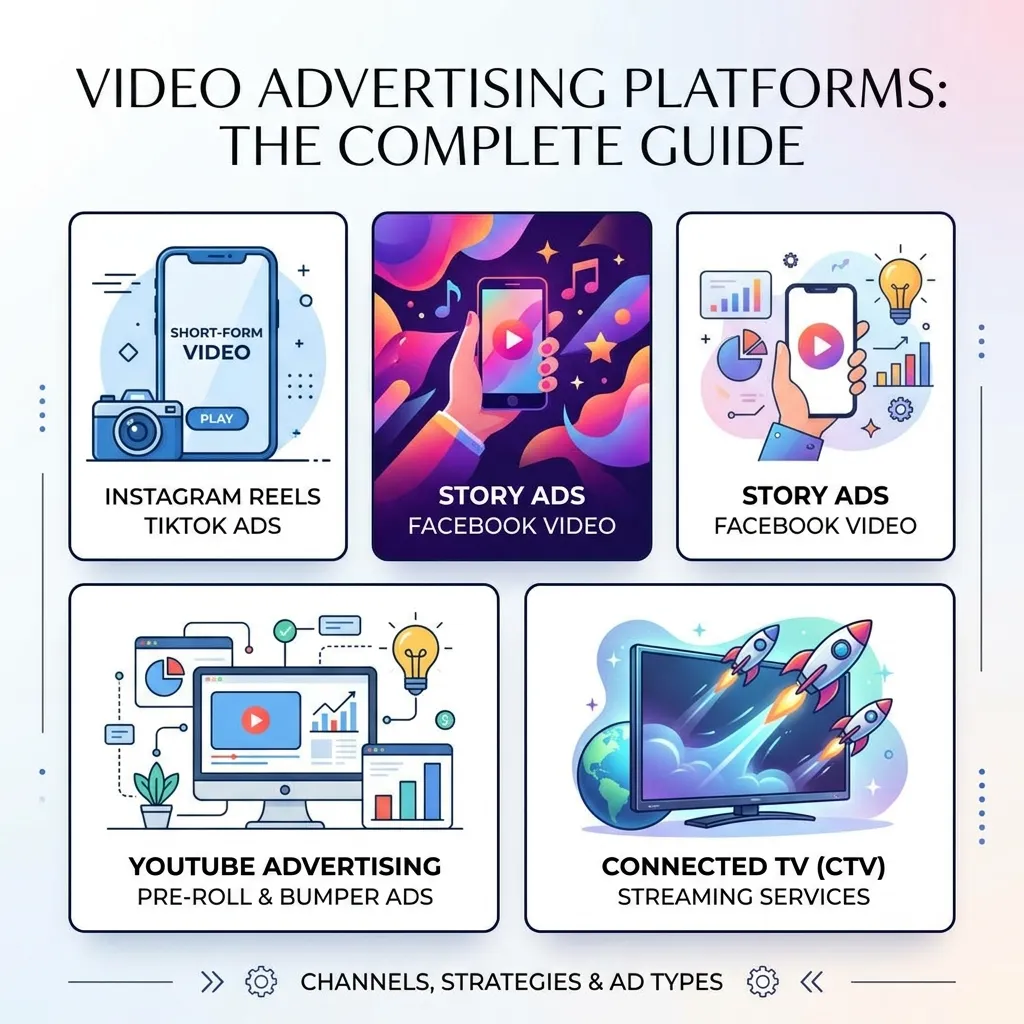
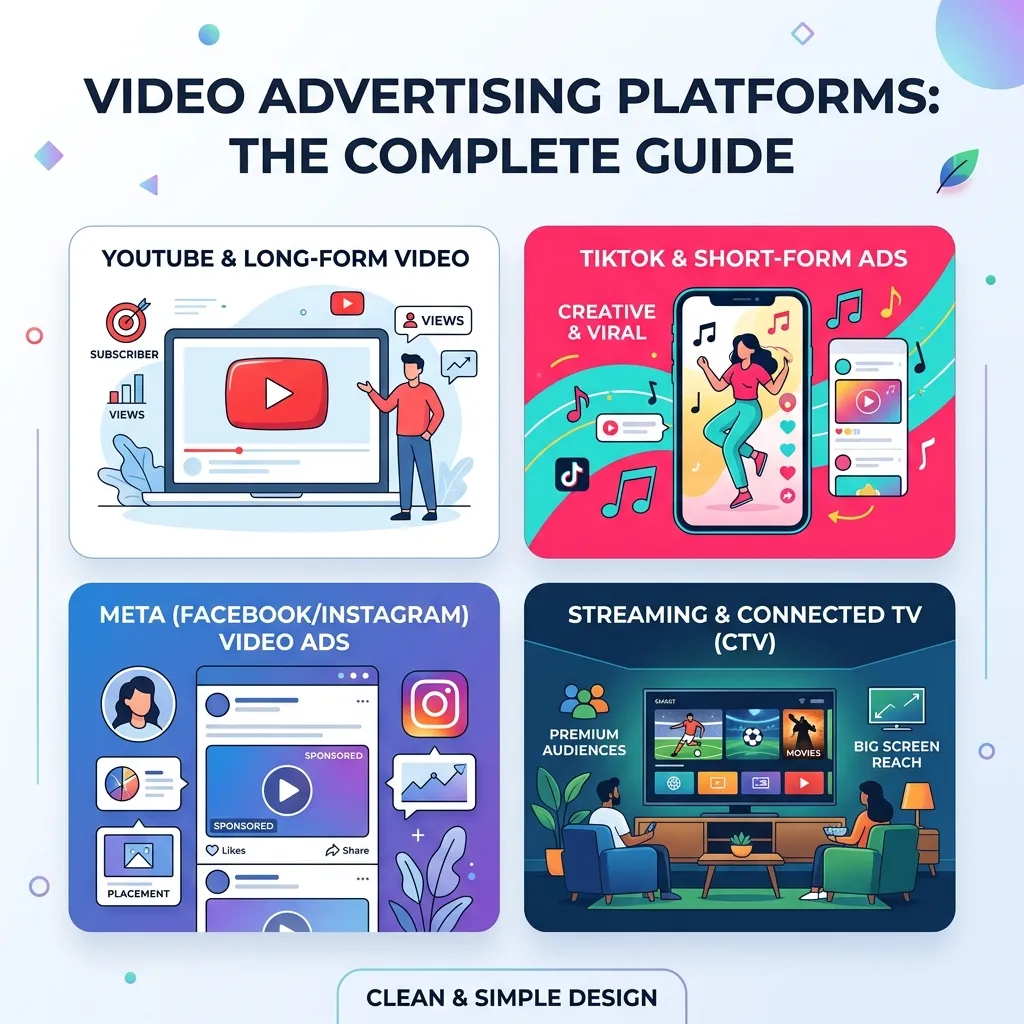
Video advertising platforms fall into three broad categories — social platforms like YouTube, Meta, and TikTok; programmatic DSPs built for scaled buying; and connected TV platforms that bring video ads to streaming devices. Each category serves a different goal, budget, and level of technical complexity, and picking the wrong one for your situation wastes spend regardless of how good the creative is. This guide breaks down what each type of platform is actually built for, how to match one to your goals, and the questions worth asking before committing budget to any of them.
The number of places you can run a video ad has expanded dramatically, and that expansion has made choosing where to spend a much harder decision than it used to be. A decade ago, video advertising largely meant YouTube pre-roll or a handful of display networks. Today it spans social feeds, connected TV streaming apps, and programmatic exchanges buying inventory across thousands of publishers simultaneously.
This guide walks through the major categories of video advertising platforms, what each one is genuinely good at, and how to think about matching a platform to your specific goal rather than defaulting to whichever one is most talked about.
The Three Main Categories of Video Advertising Platforms
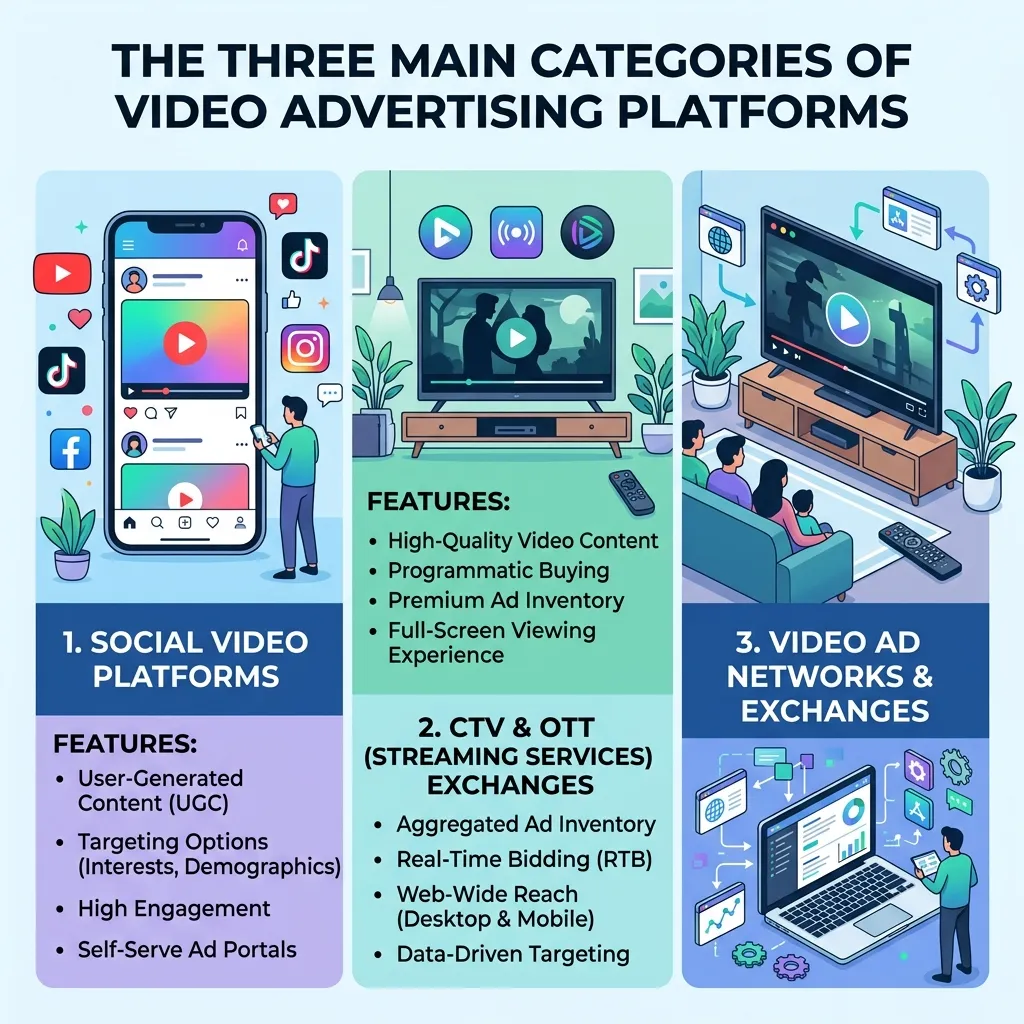
Nearly every video advertising platform fits into one of three broad categories, and understanding which category solves your specific problem is the fastest way to narrow a long list of options.
Social video platforms run ads directly within a social feed or app experience — think YouTube, Meta’s Facebook and Instagram placements, and TikTok. These platforms excel at reaching broad audiences with strong targeting based on interests and behavior, and they’re generally the easiest starting point for a business without a dedicated media buying team.
Programmatic platforms, often called demand-side platforms or DSPs, let advertisers buy video inventory across many publishers and exchanges at once, with automated bidding optimizing delivery in real time. Google’s Display & Video 360, Amazon DSP, and The Trade Desk are commonly cited examples in this category, and they typically require more setup and expertise than social platforms but offer far greater reach and control over exactly where ads appear.
Connected TV platforms deliver video ads to streaming devices and smart TVs rather than mobile or desktop screens. Roku, Amazon’s Fire TV inventory, and Samsung’s ad-supported inventory fall into this category, and this segment has grown rapidly as more viewing time shifts away from traditional cable.
Social Video Advertising Platforms
Social platforms remain the most accessible entry point into video advertising for most businesses, since self-serve ad managers let you launch a campaign without programmatic buying expertise or a large minimum budget. YouTube offers a range of ad formats from skippable pre-roll to short-form Shorts placements, and its integration with Google’s broader targeting and search intent data makes it a strong choice for both awareness and direct response goals. Meta’s video placements across Facebook and Instagram benefit from detailed interest and behavioral targeting, and the platform’s automated optimization tools have made campaign setup considerably simpler than it used to be. TikTok has carved out a distinct advantage with short-form, native-feeling video content that often performs better when it doesn’t look like a traditional polished ad.
Choosing between these platforms usually comes down to where your specific audience actually spends time and what format matches your creative strengths, more than any single platform being universally superior. Our guide to different types of video advertising breaks down which formats work best on which platforms in more detail.
Programmatic Video Advertising Platforms
Programmatic platforms exist for advertisers who need scale, precision, and access to premium publisher inventory beyond what a single social platform’s walled garden provides. Google’s Display & Video 360 gives advertisers access to a vast pool of display and video inventory alongside Google’s first-party data, making it a common choice for brands already invested in the broader Google ecosystem. The Trade Desk is frequently cited as the leading independent DSP, valued specifically for its transparency and neutrality compared to platforms tied to a single publisher’s ecosystem. Amazon DSP stands out for advertisers who want to combine video reach with Amazon’s retail and purchase-intent data, which is particularly valuable for ecommerce brands looking to close the loop between ad exposure and actual sales.
Programmatic buying generally requires more setup, a larger minimum budget to be efficient, and either in-house expertise or an agency partner to manage bidding strategy effectively. It’s rarely the right starting point for a business just beginning to experiment with video ads, but it becomes increasingly valuable once a brand has proven creative that’s ready to scale beyond what social platforms alone can deliver.
Connected TV (CTV) Advertising Platforms
CTV has become one of the fastest-growing categories of video advertising platforms as more households shift viewing time to streaming apps rather than traditional cable. Roku holds a significant share of open programmatic CTV inventory in the US market and offers advertisers access to both its own first-party household data and inventory across its streaming channel ecosystem. Amazon’s CTV inventory, spanning Fire TV and Prime Video placements, pairs streaming reach with the same retail data advantage Amazon DSP offers for other video formats. Samsung’s ad-supported smart TV inventory has also become a meaningful complement to Roku and Amazon-anchored buys for advertisers building broader streaming reach.
CTV advertising blends the branding power traditional television has always offered with the audience targeting and measurement precision of digital campaigns. This overlap is worth understanding in context — our companion analysis comparing traditional TV advertising to digital advertising covers how CTV sits at the intersection of both worlds, borrowing strengths from each rather than fitting neatly into either category alone.
How to Choose the Right Video Advertising Platform for Your Goals
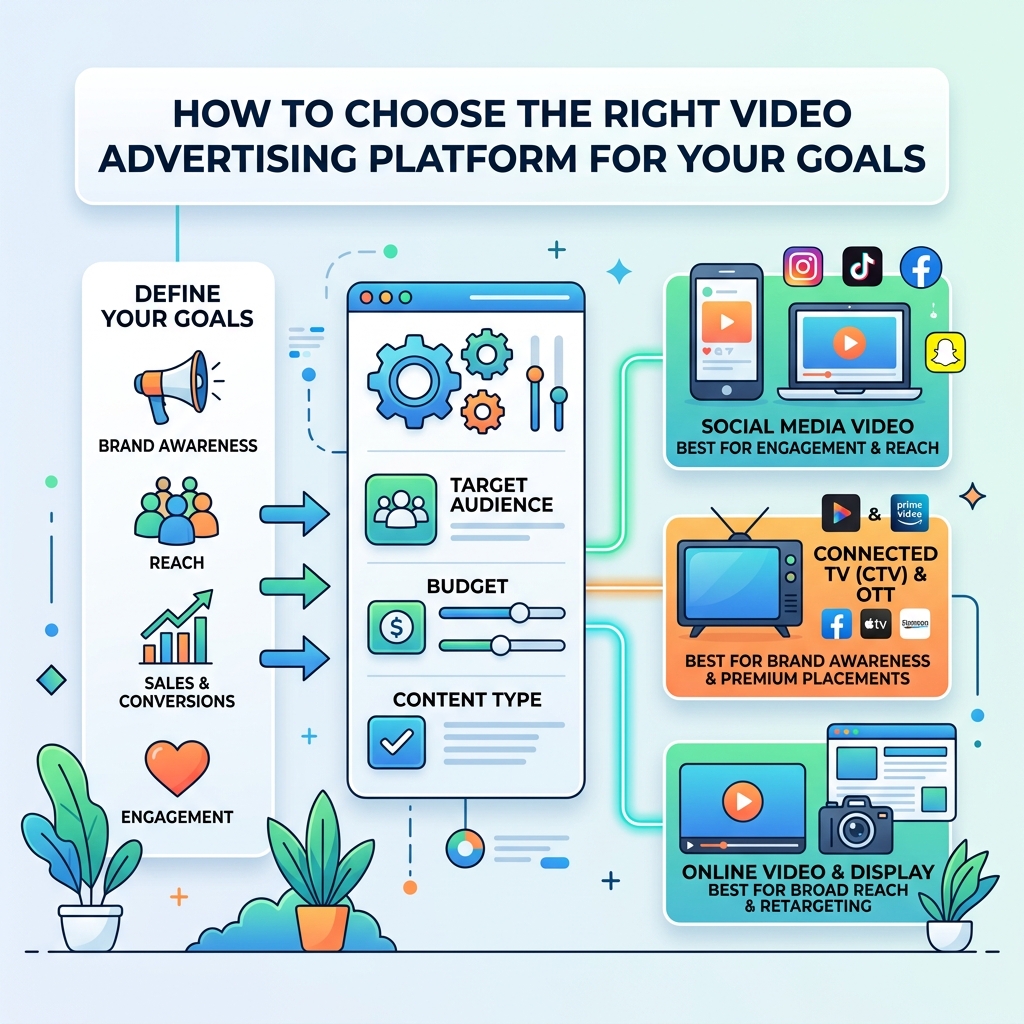
Rather than starting from which platform is trending, work through these questions to narrow the field:
- What’s your primary objective? Broad awareness campaigns often perform well on social and CTV platforms, while direct-response goals may be better served by programmatic platforms with precise retargeting capabilities.
- Where does your specific audience actually spend time? A platform’s overall scale matters less than whether your target audience is genuinely active there.
- What’s your budget and internal expertise? Social platforms are accessible with modest budgets and minimal setup; programmatic and CTV buying generally reward larger budgets and more hands-on management.
- What creative format do you already have or can realistically produce? Short, native-feeling clips suit social feeds, while longer, more polished content tends to perform better in CTV environments that mimic traditional television viewing.
- How will you measure success? Different platforms offer different attribution models, and mismatched measurement expectations are one of the most common sources of disappointment after a campaign launches.
Combining Platforms for a Full-Funnel Strategy
Most mature strategies built around video advertising platforms don’t rely on a single platform category — they layer social, programmatic, and CTV together to cover different stages of the funnel. Social platforms often drive top-of-funnel awareness and initial engagement, programmatic buying extends reach efficiently across the open web, and CTV reinforces brand messaging in a premium, high-attention viewing environment. Retargeting audiences who engaged with a social ad through a subsequent CTV or programmatic placement is a common tactic for reinforcing a message across multiple touchpoints rather than relying on a single exposure to do all the work.
Budget allocation across these categories should reflect where you are in a campaign’s lifecycle. Early-stage testing usually makes more sense on accessible, lower-commitment social platforms before scaling proven creative into programmatic or CTV buys that require larger budgets to run efficiently.
Measuring Performance Across Different Platform Types
Attribution looks different depending on which category of video advertising platforms you’re using. Social platforms typically offer in-platform reporting with reasonably direct attribution for clicks and conversions, though privacy changes across the industry have made this less precise than it once was. Programmatic platforms often require third-party measurement tools or a dedicated analytics setup to consolidate performance across the many publishers a single campaign might touch. CTV measurement is generally the least precise of the three, since streaming ad exposure is harder to tie directly to a specific conversion event, though platform-level tools have steadily improved. Our guide to measuring video marketing success covers the core metrics worth tracking regardless of which platform category you’re evaluating.
Common Mistakes When Choosing Video Advertising Platforms
- Chasing the newest platform without a clear fit. A trending platform isn’t automatically the right choice if your target audience isn’t genuinely active there.
- Jumping into programmatic too early. Businesses without proven creative or a clear budget for efficient scale often get better early results from simpler social platforms first.
- Ignoring format differences between platforms. Reusing the exact same creative across social, programmatic, and CTV placements without adapting length and style typically underperforms compared to platform-specific versions.
- Underestimating measurement complexity. Committing budget to programmatic or CTV without a plan for consolidated reporting makes it difficult to judge whether the investment is actually working.
- Treating platforms as interchangeable. Each category serves a different role in the funnel, and expecting a CTV brand campaign to deliver the same direct-response results as a retargeting-focused programmatic buy sets the wrong expectations from the start.
Where Video Advertising Platforms Are Headed
The lines between these three categories of video advertising platforms have started to blur. Social platforms increasingly offer their own connected TV-style placements, and CTV platforms are adopting the kind of granular audience targeting that used to be exclusive to programmatic and social buying. AI-driven creative optimization is also becoming standard across most video advertising platforms, automatically testing variations of a video ad to identify which version performs best for a given audience segment without requiring a media buyer to manually build and monitor each version.
This convergence doesn’t eliminate the usefulness of thinking in three distinct categories — the underlying strengths of social reach, programmatic scale, and CTV’s premium attention still hold — but it does mean the platforms worth evaluating within each category can shift meaningfully from year to year. Revisiting your platform mix periodically, rather than treating an initial choice as permanent, keeps a video advertising strategy aligned with where audiences and ad formats are actually moving.
Budgeting Realistically Across Platform Types
Understanding what different platforms and ad formats typically cost helps set realistic expectations before committing budget. Our breakdown of video advertising costs covers how pricing varies across formats and platform types, which is worth reviewing alongside the platform categories in this guide since cost efficiency varies enormously depending on which category and specific platform you choose.
A Similar Discipline Applies to Any Ad Spend Decision
Choosing where to allocate ad budget by matching platform strengths to specific goals is a discipline that extends well beyond video specifically. The same logic that applies to picking between social, programmatic, and CTV platforms applies just as directly to broader paid acquisition planning. Ecompromotion’s complete guide to PPC advertising covers this same fit-first approach for paid search and display, reinforcing a principle worth carrying into any advertising channel decision: start from the specific goal and audience, then work backward to the platform, rather than starting from the platform and hoping the goal fits.
Conclusion
Video advertising platforms split into three broad categories, each solving a different problem: social platforms for accessible, targeted reach; programmatic DSPs for scaled buying across premium inventory; and CTV platforms for high-attention streaming exposure. The right choice depends on your objective, budget, creative assets, and how precisely you need to measure results, not on which platform happens to be generating the most industry buzz. Most effective strategies eventually combine more than one category, layering awareness, retargeting, and premium exposure together rather than relying on a single platform to carry an entire campaign. Start with a clear goal, match it to the platform category built to serve it, and expand into additional categories once you have proven creative and a measurement plan that can keep up with the added complexity.
Frequently Asked Questions About Marketing Automation Software
What is the single best marketing automation software?
There isn’t one universal answer — the right platform depends on your business size, buyer journey, and whether you need deep CRM integration, ecommerce-specific features, or enterprise-scale complexity.
Is HubSpot the best marketing automation software for small businesses?
HubSpot works well for businesses that want CRM and marketing tightly integrated, but its pricing can climb quickly at higher tiers, so simpler SMB-focused platforms may be a better fit for very small teams.
What’s the difference between SMB and enterprise-grade marketing automation software?
SMB platforms prioritize ease of use and fast setup, while enterprise suites offer deeper lead scoring, account-based marketing, and attribution capabilities but require more implementation and ongoing administration.
Is Klaviyo considered marketing automation software?
Yes, Klaviyo is a marketing automation platform built specifically for ecommerce, with deep integration into store and purchase data that general-purpose platforms don’t always match.
Do I need a CRM before choosing marketing automation software?
Not necessarily. Some platforms include a native CRM, while others are designed to integrate with a CRM you already use, so the right choice depends on your existing tech stack.
How much does marketing automation software typically cost?
Costs vary widely by platform and tier, with SMB-friendly tools generally more affordable at entry level and enterprise suites requiring significantly larger budgets and implementation investment.
What features matter most when comparing marketing automation platforms?
Workflow automation depth, native integrations, segmentation, lead scoring, and reporting that ties activity back to actual revenue outcomes are the features most worth comparing closely.
Can a small business outgrow its marketing automation software?
Yes. As buyer journeys, team size, and campaign complexity grow, businesses often need to migrate to a platform with deeper automation logic or tighter CRM integration than what they started with.
Is AI a meaningful differentiator between marketing automation platforms in 2026?
AI capability is now common across most platforms, but maturity varies significantly, so it’s worth testing actual AI features rather than relying on marketing claims alone.
Should I choose marketing automation software based on price or features first?
Neither in isolation. The better approach is defining your actual workflow needs first, then comparing platforms that meet those needs at a price your business can sustain long-term.
What’s the biggest risk of choosing the wrong marketing automation software?
Automating a poorly defined process, which scales confusion and wasted effort rather than genuine efficiency, regardless of how powerful the underlying platform is.
How often should a business re-evaluate its marketing automation software?
Reviewing your platform choice annually, or whenever your buyer journey or team size changes significantly, helps confirm that what you once considered the best marketing automation software for your situation still fits, rather than assuming the original choice remains correct indefinitely.