
Video advertising has become one of the most effective ways for businesses to capture attention, explain products, and drive conversions. However, one of the first questions marketers ask is: How much does video advertising cost?
The answer depends on several factors, including the advertising platform, video production quality, campaign objective, audience targeting, ad placement, campaign duration, and bidding model. A small business may start with a modest budget, while larger brands can spend thousands or more on production and media placement.
Understanding video advertising cost helps businesses build realistic budgets, choose the right platforms, and avoid spending money without a clear return. This guide explains the major costs involved in video advertising and how businesses can plan campaigns effectively.
What Is Video Advertising Cost?
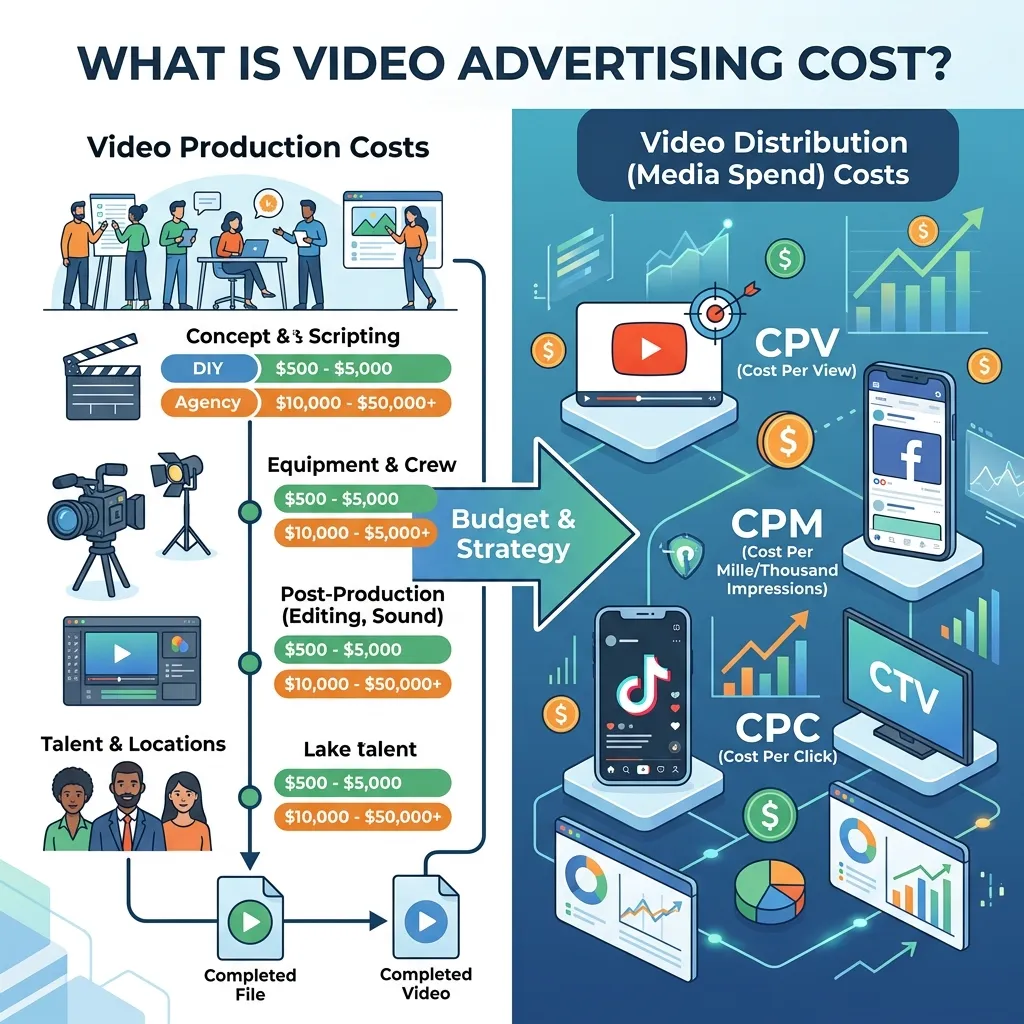
Video advertising cost refers to the total amount a business spends to create, distribute, and promote video advertisements. It can include video production, editing, advertising placement, audience targeting, creative development, and campaign management.
Unlike traditional advertising, video advertising can operate through different pricing models. Depending on the platform, advertisers may pay for impressions, views, clicks, or completed video views.
The total cost can therefore be divided into two major categories:
- Video production cost
- Video media or placement cost
Some campaigns also require additional expenses for creative strategy, professional voiceovers, animation, landing pages, tracking, and campaign management.
How Much Does Video Advertising Cost?
There is no single fixed price for video advertising. A campaign can cost relatively little when businesses create simple videos and promote them through targeted digital platforms. Professional campaigns with high-end production and large media budgets can cost considerably more.
A basic video campaign may involve:
| Cost Area | Typical Consideration |
|---|---|
| Video production | Script, filming, animation, editing |
| Creative development | Concept, storyboard, messaging |
| Media placement | Cost to show the advertisement |
| Audience targeting | Geographic, demographic, behavioral targeting |
| Campaign management | Setup, optimization, reporting |
| Tracking | Analytics, conversion tracking, attribution |
The final budget should be based on the campaign’s objective rather than choosing a random advertising amount.
Factors That Affect Video Advertising Cost
Several factors can influence the total cost of a video advertising campaign.
1. Video Production Quality
Production quality is one of the biggest variables. A simple promotional video created with basic equipment may require a relatively small budget. A commercial involving professional actors, locations, equipment, lighting, animation, and extensive editing can cost significantly more.
Businesses should choose production quality according to their audience and campaign goals.
2. Advertising Platform
Different platforms use different pricing systems. Video advertising costs can vary considerably between social media platforms, streaming services, search platforms, connected TV, and other digital channels.
A platform that charges primarily based on impressions may produce a different cost structure from one that charges based on video views or clicks.
3. Audience Targeting
The more specific the audience, the more campaign variables need to be considered. Advertisers can target audiences based on factors such as:
- Location
- Age
- Interests
- Online behavior
- Search activity
- Demographics
- Customer segments
Highly competitive audiences may require higher bids to reach effectively.
4. Campaign Duration
A longer campaign generally requires a larger total media budget. However, campaign duration should not be confused with daily spending.
A business can control total expenditure by setting a daily or lifetime budget and adjusting it based on campaign performance.
5. Ad Placement
Where the advertisement appears can influence cost and performance. Video ads may appear before, during, or after content, within social feeds, on websites, or across streaming environments.
Premium placements may provide greater visibility but can also require higher budgets.
6. Competition
Advertiser competition can affect media prices. When multiple businesses compete for the same audience, available inventory can become more expensive.
This is why campaign costs may vary depending on the market, season, audience, and advertising environment.
Video Advertising Production Cost vs Media Cost
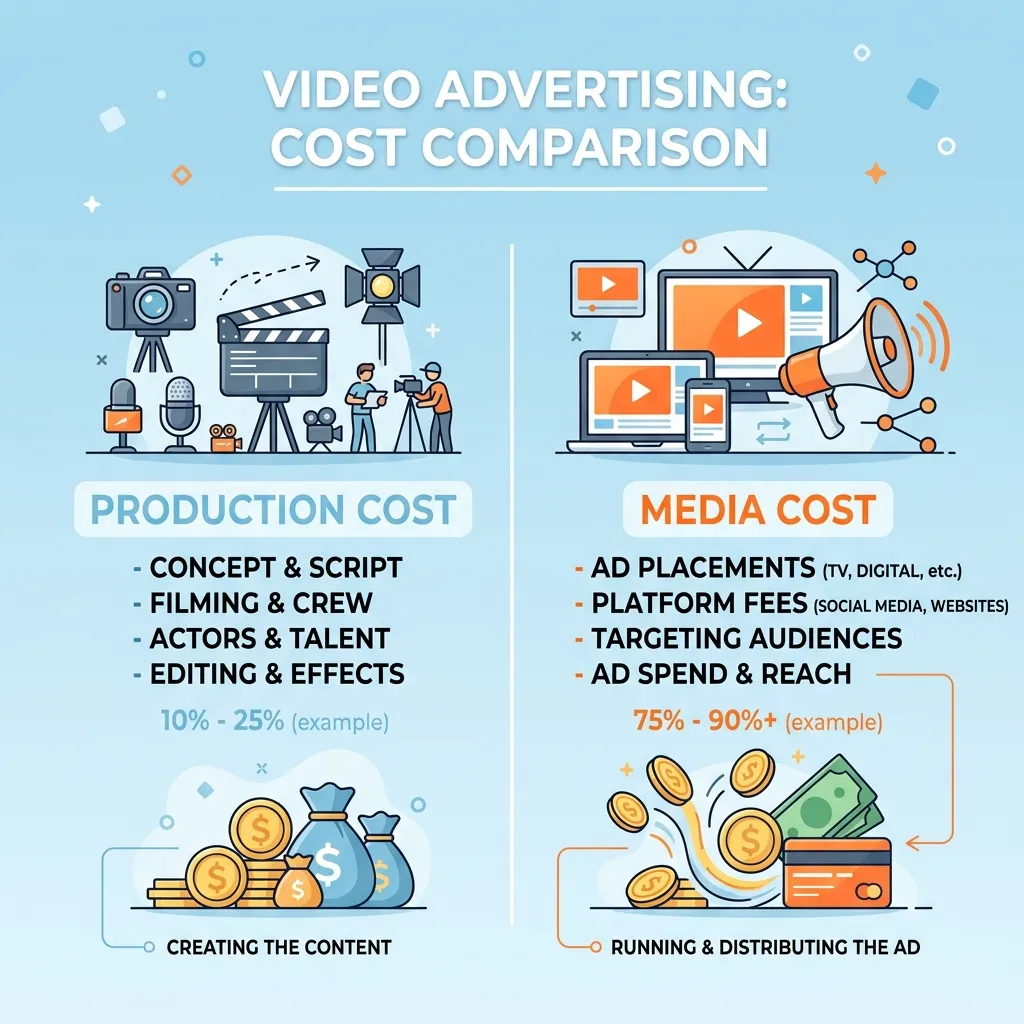
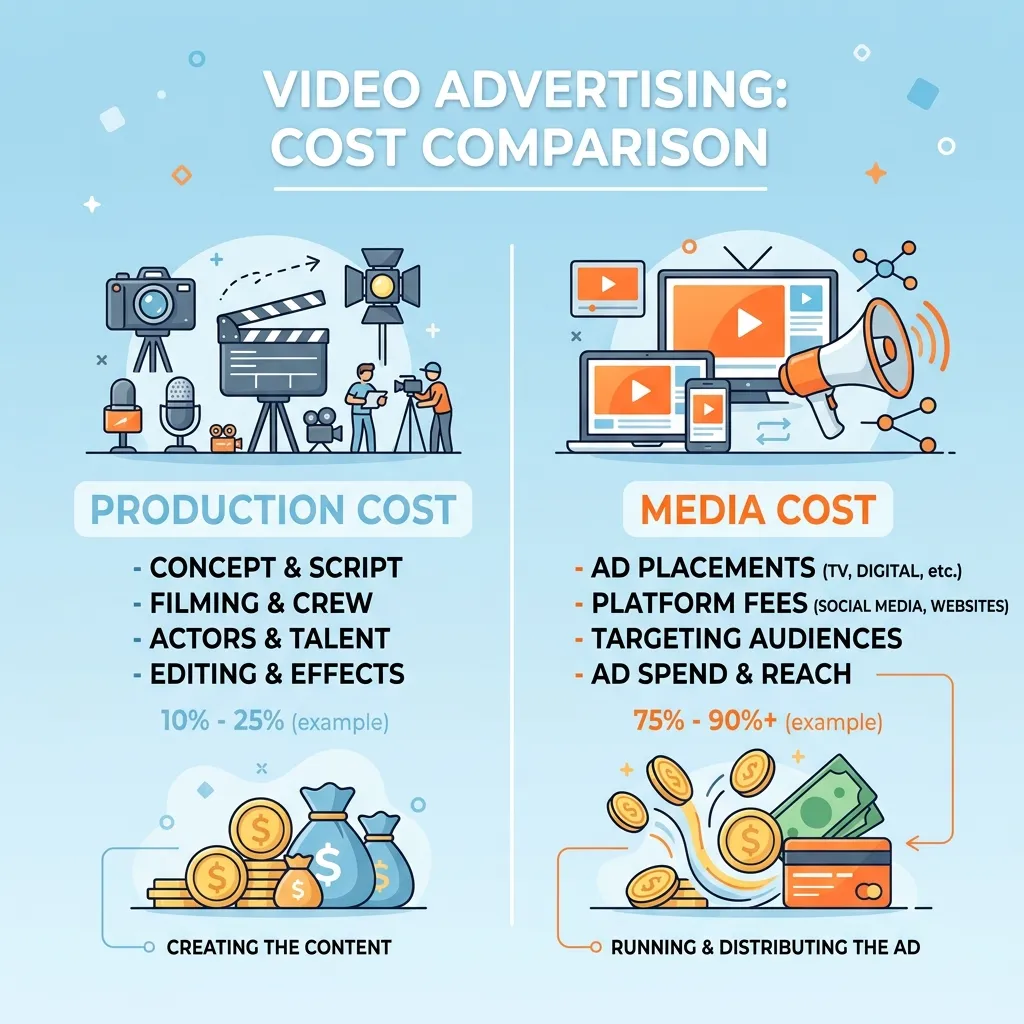
One of the most important budgeting decisions is separating production costs from media costs.
Production cost covers the creation of the advertisement. This may include:
- Scriptwriting
- Storyboarding
- Filming
- Actors
- Voiceovers
- Motion graphics
- Animation
- Editing
- Music and sound design
Media cost covers distributing the finished advertisement to the target audience.
For example, a business could spend $1,000 creating a video and another $2,000 promoting it. In this situation, the campaign’s total direct advertising investment would be $3,000 before any additional management or tracking expenses.
Keeping these costs separate makes campaign analysis easier.
Video Advertising Cost by Platform
The cost of video advertising varies by platform because each channel has different audiences, bidding systems, targeting options, and advertising inventory.
YouTube Video Advertising Cost
YouTube allows advertisers to reach audiences based on interests, search behavior, demographics, topics, keywords, and other targeting signals.
Depending on the campaign type, advertisers may pay based on impressions, views, or other engagement and conversion-related metrics.
YouTube can be useful for businesses that want both broad awareness and measurable performance.
Social Media Video Advertising Cost
Platforms such as Facebook, Instagram, TikTok, and LinkedIn support video advertising with different targeting and bidding options.
Social media video campaigns can be particularly useful for:
- Brand awareness
- Product discovery
- Lead generation
- Website traffic
- Retargeting
- Product promotion
Costs depend heavily on audience competition, campaign objective, creative quality, and optimization.
Connected TV Video Advertising Cost
Connected TV advertising allows brands to reach audiences through internet-connected televisions and streaming environments.
Because connected TV can combine television-style viewing with digital targeting capabilities, it may be useful for brands seeking high-quality video exposure.
The cost can depend on audience, inventory, targeting, geography, and campaign scale.
Common Video Advertising Pricing Models
Understanding pricing models makes it easier to estimate campaign expenses.read more details : CPA vs CPC vs CPL vs CPM
Cost Per Mille (CPM)
CPM refers to the cost of reaching one thousand impressions.
The formula is:
CPM = Advertising Cost ÷ Impressions × 1,000
For example, if a campaign spends $500 and generates 100,000 impressions:
CPM = $500 ÷ 100,000 × 1,000 = $5
CPM is commonly used when the primary goal is reach or awareness.
Cost Per View (CPV)
CPV measures the cost associated with video views.
It can be useful for campaigns where advertisers want users to actively watch the advertisement rather than simply having it displayed.
Cost Per Click (CPC)
CPC measures the amount paid for clicks generated by an advertisement.
This model can be useful when the campaign objective is website traffic or another measurable action.
Cost Per Acquisition (CPA)
CPA measures the cost required to generate a specific conversion or acquisition.
The formula is:
CPA = Total Campaign Cost ÷ Number of Conversions
CPA can be more meaningful than impressions when the primary goal is generating customers or leads.
How to Create a Video Advertising Budget
Creating a video advertising budget does not require guessing. Businesses can build their budget around objectives, audience size, campaign duration, and expected performance.
Step 1: Define the Campaign Objective
First, decide what the campaign needs to accomplish.
Possible objectives include:
- Increasing brand awareness
- Generating website traffic
- Collecting leads
- Increasing product sales
- Promoting an offer
- Retargeting existing visitors
- Launching a new product
The objective influences the platform, creative strategy, and measurement approach.
Step 2: Determine Your Target Audience
Define who should see the advertisement.
Consider:
- Location
- Customer demographics
- Interests
- Purchasing behavior
- Existing customer segments
- Potential customer needs
A clear audience helps reduce wasted advertising expenditure.
Step 3: Set a Media Budget
Determine how much you are willing to spend on advertising placement.
A useful approach is to start with a controlled test budget rather than committing the entire marketing budget immediately.
Step 4: Allocate Production Costs
Decide how much should be invested in creating the video.
Not every campaign needs an expensive commercial. A well-written message, strong visual structure, and clear call to action can often matter more than unnecessary production complexity.
Step 5: Reserve a Testing Budget
Keep part of the budget for testing different:
- Video openings
- Headlines
- Calls to action
- Audiences
- Placements
- Video lengths
Testing can reveal which combinations produce better results.
How to Reduce Video Advertising Cost
Businesses do not always need to increase spending to improve campaign performance. Better planning can help reduce wasted expenditure.
Repurpose Existing Content
A single long-form video can sometimes be converted into multiple shorter advertisements, social clips, and remarketing creatives.
This allows businesses to get more value from one production project.
Use Shorter Videos
Short videos can reduce production complexity and make it easier to create multiple creative variations.
However, length should always match the message and platform.
Start With a Test Campaign
Instead of immediately spending a large amount, run a smaller campaign to evaluate audience response.
Once successful audiences and creatives are identified, the campaign can be scaled.
Improve Targeting
Poor targeting can cause advertising budgets to be spent on people who are unlikely to become customers.
Refining audience targeting can improve the efficiency of every advertising dollar.
Improve the First Few Seconds
The opening of a video is extremely important. If viewers immediately lose interest, the rest of the advertisement may never be seen.
Use the opening to quickly communicate:
- The problem
- The benefit
- The offer
- The product
- The reason to keep watching
How to Measure Video Advertising ROI
Measuring performance is essential because a low advertising cost does not necessarily mean a successful campaign.
Businesses should track metrics such as:
- Impressions
- Video views
- View-through rate
- Click-through rate
- Website visits
- Leads
- Conversions
- Customer acquisition cost
- Revenue
- Return on ad spend
Return on Ad Spend
ROAS measures revenue generated compared with advertising expenditure.
The formula is:
ROAS = Revenue Generated ÷ Advertising Spend
For example, if a business spends $2,000 on advertising and generates $8,000 in attributable revenue:
ROAS = $8,000 ÷ $2,000 = 4
That means the campaign generated $4 in revenue for every $1 spent on advertising.
Video Advertising Cost vs Traditional Advertising
Video advertising can exist across both digital and traditional media environments.
Traditional television advertising often involves media placement, production, scheduling, and audience reach considerations. Digital video advertising can provide additional targeting, tracking, optimization, and performance measurement capabilities.
The right choice depends on the business objective.
A local business focused on a specific geographic area may prioritize targeted digital video. A large brand seeking broad awareness may combine video advertising with television or connected TV campaigns.
Is Video Advertising Worth the Cost?
Video advertising can be worth the investment when the campaign has a clear objective, relevant audience, strong creative, and reliable measurement system.
The goal should not simply be to obtain the cheapest views. Instead, businesses should focus on reaching the right people with the right message and encouraging meaningful action.
A campaign that costs more but generates qualified customers may be more valuable than a cheaper campaign that produces large numbers of low-quality views.
Common Video Advertising Cost Mistakes
Businesses can waste money when they focus only on the advertising budget and ignore campaign strategy.
Common mistakes include:
- Creating expensive videos without testing the message
- Targeting audiences too broadly
- Ignoring campaign objectives
- Measuring views but not conversions
- Using the same creative for every audience
- Spending the full budget before testing
- Failing to optimize campaigns
- Ignoring landing-page performance
Avoiding these mistakes can make the overall advertising investment more efficient.
Video Advertising Cost: A Practical Budgeting Framework
A simple budgeting framework can help businesses organize their spending.
| Budget Area | Purpose |
|---|---|
| Creative development | Strategy, concept, and script |
| Production | Filming, animation, editing |
| Media | Distribution and advertising placement |
| Testing | Creative and audience experiments |
| Optimization | Campaign improvements |
| Measurement | Tracking and reporting |
The exact percentage allocated to each area should depend on the business, campaign objective, platform, and available resources.
Final Thoughts
Video advertising cost depends on much more than the price of creating a video. Production, media placement, audience targeting, campaign duration, platform selection, and optimization all influence the final investment.
The most effective approach is to establish a clear objective, identify the right audience, create relevant video content, start with a controlled budget, and continuously measure performance. By focusing on outcomes rather than simply minimizing costs, businesses can use video advertising as a scalable tool for awareness, leads, and sales.
Frequently Asked Questions
What is the average video advertising cost?
There is no universal average because costs vary by platform, audience, production quality, campaign objective, and advertising model. A small campaign can require a modest budget, while large campaigns may require significantly more.
How much does it cost to make a video advertisement?
Video production costs depend on the complexity of the project. Simple promotional videos can be inexpensive, while professional commercials involving actors, locations, equipment, animation, and extensive post-production can cost much more.
Is video advertising expensive?
Video advertising can be expensive when production and media costs are high, but businesses can control spending through budgets, targeting, testing, and platform selection.
What is the cheapest way to advertise a video?
Creating simple, reusable video content and testing it through targeted digital campaigns can help businesses control costs. The cheapest option is not always the most effective, however.
Does video advertising increase sales?
Video advertising can contribute to sales by increasing awareness, explaining products, building interest, and encouraging customers to take action. Results depend on targeting, creative quality, offer, and campaign execution.
What is CPV in video advertising?
CPV means Cost Per View. It measures the amount an advertiser pays for video views under a CPV-based advertising model.
What is CPM in video advertising?
CPM means Cost Per Mille, or cost per one thousand impressions. It is commonly used to evaluate the cost of reaching an audience.
How can businesses lower video advertising costs?
Businesses can lower wasted expenditure by testing creatives, improving audience targeting, repurposing content, optimizing campaigns, and measuring conversions.
Should small businesses use video advertising?
Yes. Small businesses can use video advertising with controlled budgets and focused targeting. They do not necessarily need large production budgets to create effective campaigns.
How do you calculate video advertising ROI?
ROI can be evaluated by comparing the revenue or profit generated from a campaign with the investment required to run it. ROAS is another useful metric for comparing revenue directly with advertising spend.