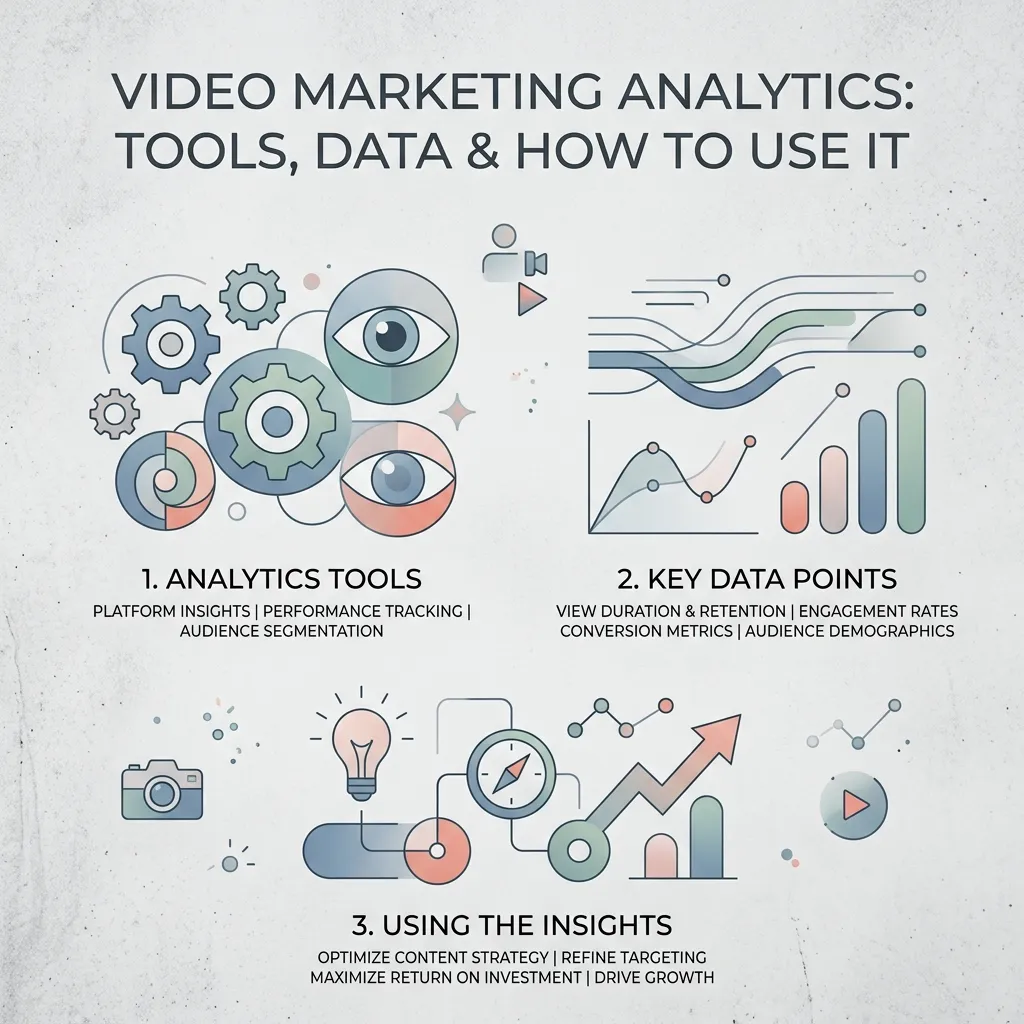
Video marketing analytics is the practice of collecting, connecting, and interpreting data across every stage of a video’s performance — from initial view to final conversion. This guide covers the core data sources available, the tools teams typically use to bring them together, how attribution complicates the picture, and how AI is changing what’s possible to measure.
A video can generate enormous amounts of data — every second watched, every click, every drop-off point is technically trackable. The problem most teams face isn’t a lack of data; it’s the difficulty of turning scattered numbers across multiple platforms into something that actually informs a decision. That’s what this practice is meant to solve: not just collecting numbers, but connecting them into a coherent picture of what’s working, what isn’t, and why.
This guide covers the core building blocks of that practice — the data sources available, the tools commonly used to bring them together, the persistent challenge of attribution, and how AI-assisted analysis is starting to change what teams can extract from viewing data. It’s meant as a practical companion for anyone trying to move from scattered platform dashboards to an actual analytics practice.
What Video Marketing Analytics Actually Covers
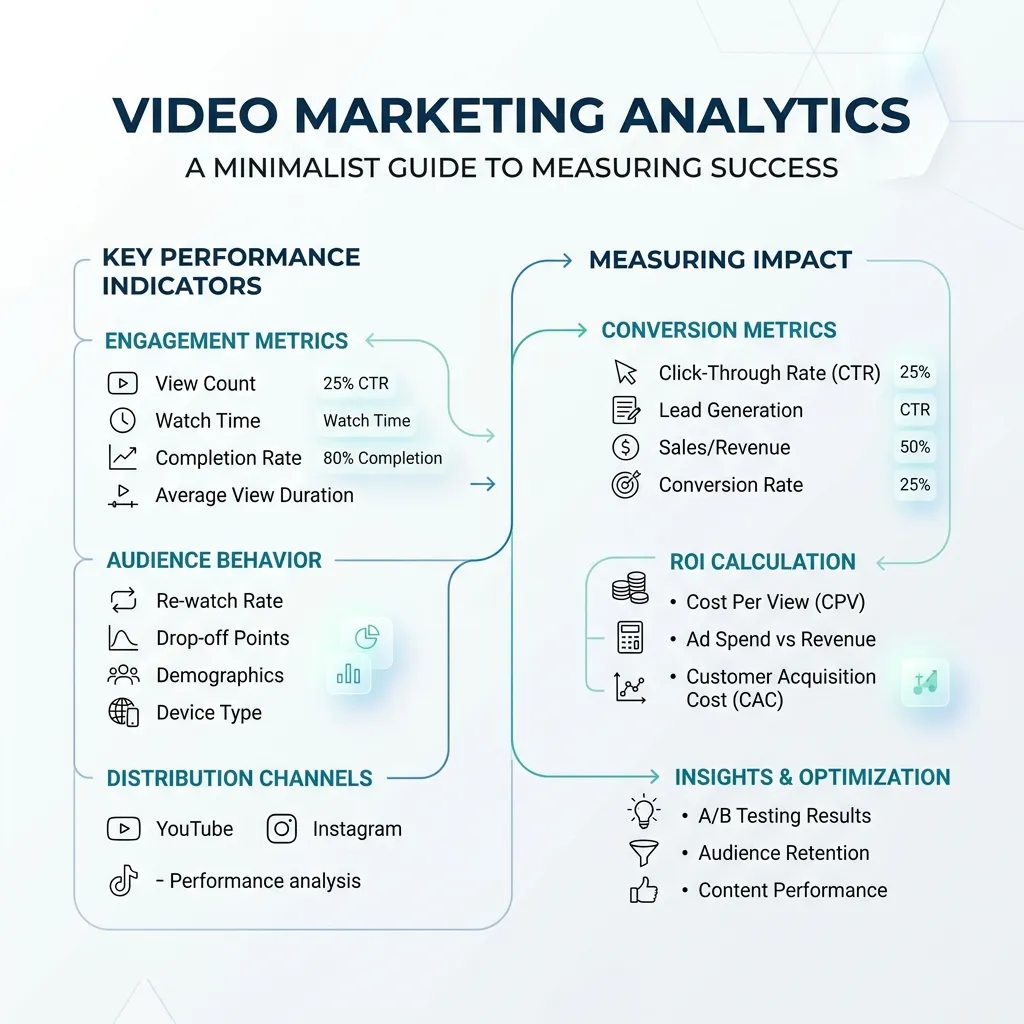
Video marketing analytics spans a wider scope than most teams initially assume. It’s not just view counts and engagement rates — a complete analytics practice covers audience behavior during playback (drop-off points, replay segments, skip patterns), cross-platform performance comparison, attribution back to business outcomes, and increasingly, qualitative signals like comment sentiment and audience composition.
The distinction matters because teams that treat this discipline as synonymous with a single platform’s dashboard tend to miss the parts of the picture that live outside that platform — what happened after someone clicked through, whether the same content performed differently across channels, and whether the audience actually matched the intended target.
Core Data Sources in Video Marketing Analytics
Native Platform Analytics
YouTube Studio, Meta’s video insights, TikTok Analytics, and LinkedIn’s video metrics all provide detailed, platform-specific data — watch time, audience retention curves, traffic sources, and demographic breakdowns. These are usually the first and most accessible layer of this analytics stack, since they require no additional setup beyond publishing content on the platform itself.
The limitation is that native analytics rarely connect cleanly to what happens after a viewer leaves the platform. A strong retention curve on YouTube says nothing about whether that viewer later visited a website or made a purchase, which is where the next layer becomes necessary.
Web and App Analytics
Connecting video performance to on-site behavior requires tagging and tracking that bridges video platforms with web analytics tools. This typically involves tracking referral traffic from video platforms, tagging video-driven landing pages distinctly from other traffic sources, and setting up conversion events that can be traced back to specific video campaigns. Our complete guide to video marketing metrics covers the technical setup involved in building this connection properly.
Ad Platform and Conversion Data
For paid video campaigns, the advertising platform itself typically provides conversion tracking, cost data, and audience targeting performance. This layer is essential for calculating cost per acquisition and return on ad spend, though it depends heavily on properly configured pixel or API-based conversion tracking, which has become more complex as privacy regulations and browser restrictions limit some forms of tracking.
CRM and Sales Data
For longer sales cycles, particularly in B2B video marketing, tying video engagement to CRM records — which leads watched which content, and what happened to them afterward — closes the loop between top-of-funnel video engagement and actual revenue. This integration is often the missing piece that prevents teams from proving video’s contribution to pipeline, since view-level data alone can’t show whether a specific viewer became a customer.
Tools Commonly Used for Video Marketing Analytics
Most teams end up combining several tool categories rather than relying on a single platform:
- Native platform dashboards for content-level performance on each individual channel
- Video hosting and analytics platforms (beyond social platforms) that offer more granular playback data, particularly useful for owned video content embedded on a website
- Web analytics platforms for connecting video-driven traffic to on-site behavior and conversions
- Business intelligence or data visualization tools for teams combining data across multiple sources into unified dashboards
- Attribution and marketing mix modeling tools for organizations trying to isolate video’s specific contribution to revenue amid multiple simultaneous marketing efforts
Our resource on how to measure video marketing success breaks down which combination of tools makes sense depending on team size, budget, and how central video is to the overall marketing strategy.
The Attribution Challenge in Video Marketing Analytics
Attribution is consistently the hardest part of this discipline to get right. Video frequently plays an influencing role earlier in a customer journey without being the final touchpoint before conversion, which means simple last-click models tend to understate its actual contribution significantly.
A few approaches help address this:
Multi-touch attribution assigns partial credit to every touchpoint in a customer’s path, giving video credit for its role even when it isn’t the final interaction before conversion. This requires more sophisticated tracking infrastructure than single-touch models but produces a more accurate picture of video’s influence.
Incrementality testing compares outcomes between an audience exposed to video content and a similar holdout audience that wasn’t, isolating video’s actual causal impact rather than relying on correlation-based attribution models. This is considered one of the more reliable methods precisely because it doesn’t depend on tracking individual user journeys, which makes it resilient to the privacy restrictions increasingly limiting other attribution approaches.
Marketing mix modeling takes a broader, aggregate-data approach, useful for understanding video’s contribution alongside other channels without requiring individual-level tracking at all. This method has grown in relevance as cookie deprecation and privacy regulation limit the accuracy of user-level tracking that other attribution methods depend on.
No single method is perfect, and most sophisticated measurement practices triangulate across two or more approaches rather than relying on any single model exclusively.
How AI Is Changing Video Marketing Analytics

AI-assisted analysis has begun to change what’s practically possible within this field, particularly around the depth of insight available from within the video itself rather than just surrounding metadata.
Scene-level and moment-level analysis can now identify exactly which seconds of a video correlate with drop-off, replay, or engagement spikes, giving editors specific, actionable feedback rather than a single aggregate completion rate. This level of granularity was previously only available through expensive manual analysis and is increasingly automated.
Sentiment analysis on comments and reactions can process volumes of qualitative feedback that would be impractical to review manually, surfacing patterns in audience response that pure behavioral metrics miss entirely.
Predictive performance modeling uses historical data to forecast how new content is likely to perform before it’s fully deployed, allowing teams to make adjustments earlier in the production process rather than only learning from results after the fact. Our AI-focused resource on AI video marketing tools covers this category in more depth, including where the technology is genuinely mature versus still emerging. Teams exploring this space alongside broader content strategy may also find it useful to review video advertising examples that have performed well, since analyzing successful creative patterns alongside performance data often reveals insights that raw metrics alone miss.
These capabilities don’t replace the fundamentals of good measurement — clear goals, clean data, and consistent tracking — but they do meaningfully expand what a team can extract from the data once those fundamentals are in place.
Building a Practical Video Marketing Analytics Workflow
A workable analytics practice doesn’t require adopting every tool and technique described above simultaneously. A reasonable sequence looks like this:
- Start with native platform data to establish a baseline understanding of content-level performance
- Connect video traffic to web analytics so that on-site behavior and conversions can be traced back to specific video content
- Layer in conversion or CRM data for campaigns where the ultimate goal is a tracked business outcome, not just engagement
- Introduce attribution methods — starting with multi-touch modeling, then incrementality testing as volume and budget justify it
- Add AI-assisted analysis once the foundational data pipeline is reliable, since AI tools amplify existing data quality rather than compensating for gaps in it
Skipping steps — particularly jumping straight to sophisticated attribution or AI analysis without clean foundational tracking — tends to produce impressive-looking but unreliable outputs.
Timing matters as much as sequencing. Many teams try to build a complete measurement stack before launching a single video campaign, which delays real learning unnecessarily. A more practical pattern is building each layer just ahead of the point where it becomes the binding constraint on decision-making — adding conversion tracking once paid spend is meaningful, for instance, rather than before any campaign exists to measure. This keeps the analytics investment proportional to what the video program actually needs at each stage, rather than front-loading infrastructure that sits unused for months.
Applying Predictive Data Beyond Video
The broader discipline of forecasting which content or campaigns are likely to perform before committing full budget isn’t unique to video. An outside resource on predictive analytics for customer journeys covers how this kind of forecasting is applied more broadly across marketing, and a related piece on predictive analytics in business ROI strategy explains how teams increasingly combine behavioral and engagement signals to prioritize where marketing investment is likely to pay off — a framework that applies directly to deciding which video concepts deserve a larger production budget before a full campaign has run its course.
Common Mistakes in Video Marketing Analytics
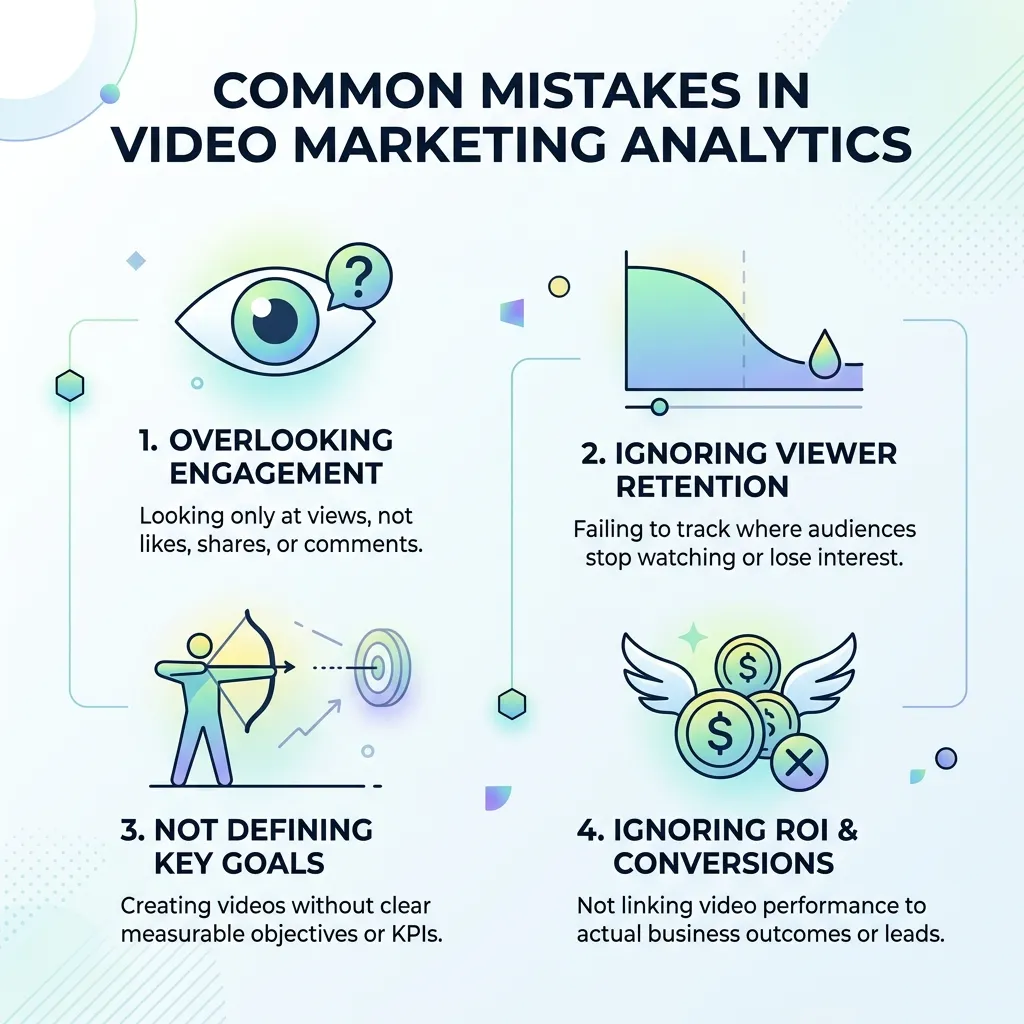
Relying entirely on native platform dashboards. These provide useful content-level data but rarely connect to actual business outcomes, leaving teams unable to answer the question that matters most: did this video help the business.
Treating every metric as equally important. Without prioritizing which numbers actually answer a specific business question, reporting becomes comprehensive but unusable, burying meaningful signals under dozens of secondary metrics.
Ignoring attribution entirely. Reporting only last-touch conversions systematically undervalues video’s contribution earlier in the customer journey, which can lead to underinvestment in content that’s actually working.
Adopting AI tools before fixing data foundations. Sophisticated analysis built on inconsistent or incomplete tracking produces outputs that look authoritative but rest on unreliable inputs.
Changing tools or metrics too frequently. Consistency in what’s measured and how matters as much as measuring the right things, since frequent changes make it difficult to identify genuine trends over time.
Conclusion
Video marketing analytics is ultimately about closing the gap between viewing data and business decisions. Native platform dashboards are a useful starting point but rarely tell the full story on their own, and building a complete picture requires connecting web analytics, conversion data, and — where the sales cycle justifies it — CRM records into a single coherent view. Attribution remains genuinely difficult, which is why most mature practices triangulate across multiple methods rather than trusting any single model completely. AI-assisted analysis is expanding what’s possible, but it works best layered on top of solid data foundations rather than as a substitute for them. Teams that build this practice deliberately end up with reporting that actually informs where to invest — not just numbers that look good in a monthly update.
Frequently Asked Questions About Video Marketing Analytics
1. What’s the Difference Between Video Marketing Analytics and Video Marketing KPIs?
KPIs are the specific metrics selected to measure success against a goal, while video marketing analytics is the broader process of collecting, connecting, and interpreting data used to produce and understand those KPIs.
2. What Data Sources Are Most Important for Video Marketing Analytics?
Native platform dashboards, web analytics connected to video traffic, advertising platform conversion data, and CRM data for longer sales cycles are key sources that teams may need to combine.
3. Why Is Attribution So Difficult in Video Marketing Analytics?
Video can influence a purchase decision without being the final touchpoint before conversion. As a result, simple last-click attribution models may underestimate video’s contribution to the customer journey.
4. What Is Incrementality Testing in Video Marketing Analytics?
Incrementality testing compares outcomes between an audience exposed to video content and a similar holdout group that was not exposed. This helps estimate the video’s causal impact rather than relying only on correlation-based attribution.
5. How Is AI Changing Video Marketing Analytics?
AI can support scene-level performance analysis, large-scale sentiment analysis of comments, and predictive modeling that forecasts potential content performance before full deployment.
6. Do Small Teams Need Sophisticated Video Marketing Analytics?
Not necessarily. Starting with native platform data and basic web analytics integration is often enough for smaller teams before adding more advanced attribution, modeling, or AI-assisted methods.
7. What’s the Risk of Relying Only on Native Platform Dashboards?
Native dashboards provide valuable content-level performance data but may not connect directly to business outcomes. This can make it difficult to determine whether video activity is contributing to leads, sales, or revenue.
8. Is Marketing Mix Modeling Relevant to Video Marketing Analytics?
Yes. Marketing mix modeling can be particularly useful when privacy restrictions limit user-level tracking. It uses aggregate data to estimate video’s contribution alongside other marketing channels.
9. How Often Should a Video Marketing Analytics Setup Be Reviewed?
Tracking and attribution setups should be reviewed periodically, especially after major platform changes, analytics updates, or privacy policy changes that could affect existing tracking configurations.
10. Can Video Marketing Analytics Predict Which Content Will Perform Well Before It’s Published?
To some degree, yes. Predictive performance models can use historical data to estimate likely results, although their accuracy depends heavily on having sufficient, consistent, and reliable historical data.
11. What’s the Biggest Mistake Teams Make When Building Video Marketing Analytics?
A common mistake is adopting sophisticated tools or attribution methods before establishing reliable foundational tracking. Advanced analysis cannot produce dependable insights when the underlying data is incomplete or inconsistent.
12. Should Video Marketing Analytics Be Handled by Marketing or a Dedicated Analytics Team?
It depends on the organization’s size and resources. Even without a dedicated analytics team, someone should have clear ownership of tracking setup, data quality, and reporting consistency to maintain reliable analytics across campaigns.