Video advertising examples show how brands can use storytelling, product demonstrations, customer experiences, humor, emotion, and short-form content to capture attention and encourage action. The most effective video ads do more than promote a product. They communicate a clear message, connect with a specific audience, and provide a strong reason to take the next step. This guide explores 15 practical video advertising examples, why they work, and how businesses can apply similar approaches to their own campaigns.
Video has become one of the most versatile formats in modern advertising. Brands can use a short social media clip to generate awareness, a product demonstration to explain a complex service, a testimonial to build trust, or a longer story-driven advertisement to create an emotional connection.
However, simply creating a video does not guarantee advertising success.
The strongest campaigns combine the right creative concept with audience targeting, persuasive messaging, appropriate distribution, and measurable calls to action. Looking at successful video advertising examples can help marketers understand how these elements work together.
A useful starting point is understanding the broader Video Advertising Strategy Guide, which explains how creative decisions fit into a complete advertising strategy.
This article focuses on the creative side: different video ad concepts, examples, formats, and practical lessons that marketers can adapt.
What Makes a Video Advertisement Effective?
Before looking at individual examples, it is important to understand why some video advertisements perform better than others.
An effective video ad usually has a clear purpose. It might introduce a brand, solve a customer problem, demonstrate a product, generate leads, encourage a purchase, or bring existing customers back to the business.
Strong video advertisements commonly combine several elements:
A Strong Opening Hook
Viewers decide quickly whether content deserves their attention.
The opening seconds should create curiosity, present a problem, show an unexpected visual, ask a relevant question, or immediately demonstrate value.
One Clear Message
Trying to communicate too many ideas can weaken an advertisement.
A strong video usually focuses on one central message and supports it with visuals, narration, demonstrations, or storytelling.
Audience Relevance
A video designed for teenagers should not necessarily use the same creative approach as an advertisement for enterprise software.
Understanding the audience influences the language, pacing, visuals, humor, emotional tone, and call to action.
A Specific Call to Action
The viewer should understand what to do next.
Depending on the campaign, the CTA could be:
- Shop now
- Learn more
- Sign up
- Download the app
- Book a demo
- Start a free trial
- Visit the website
- Subscribe
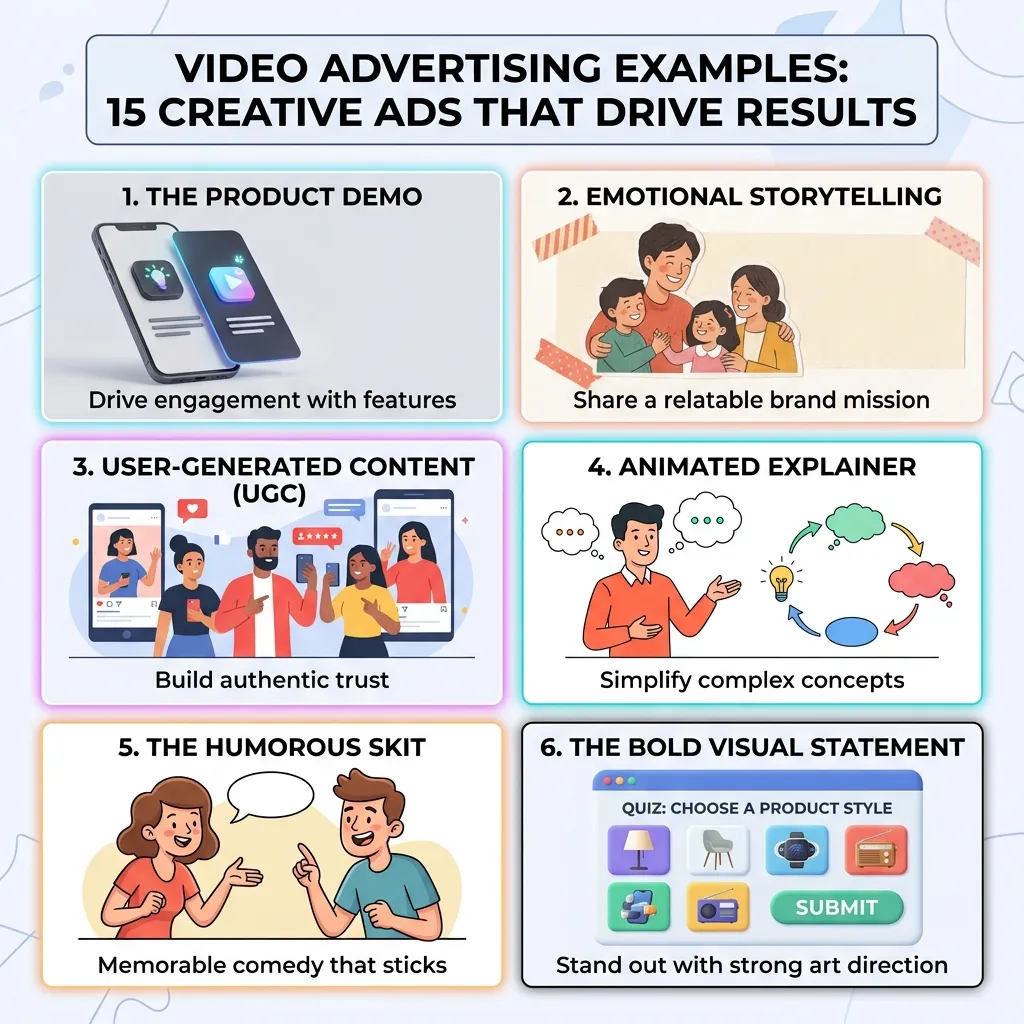
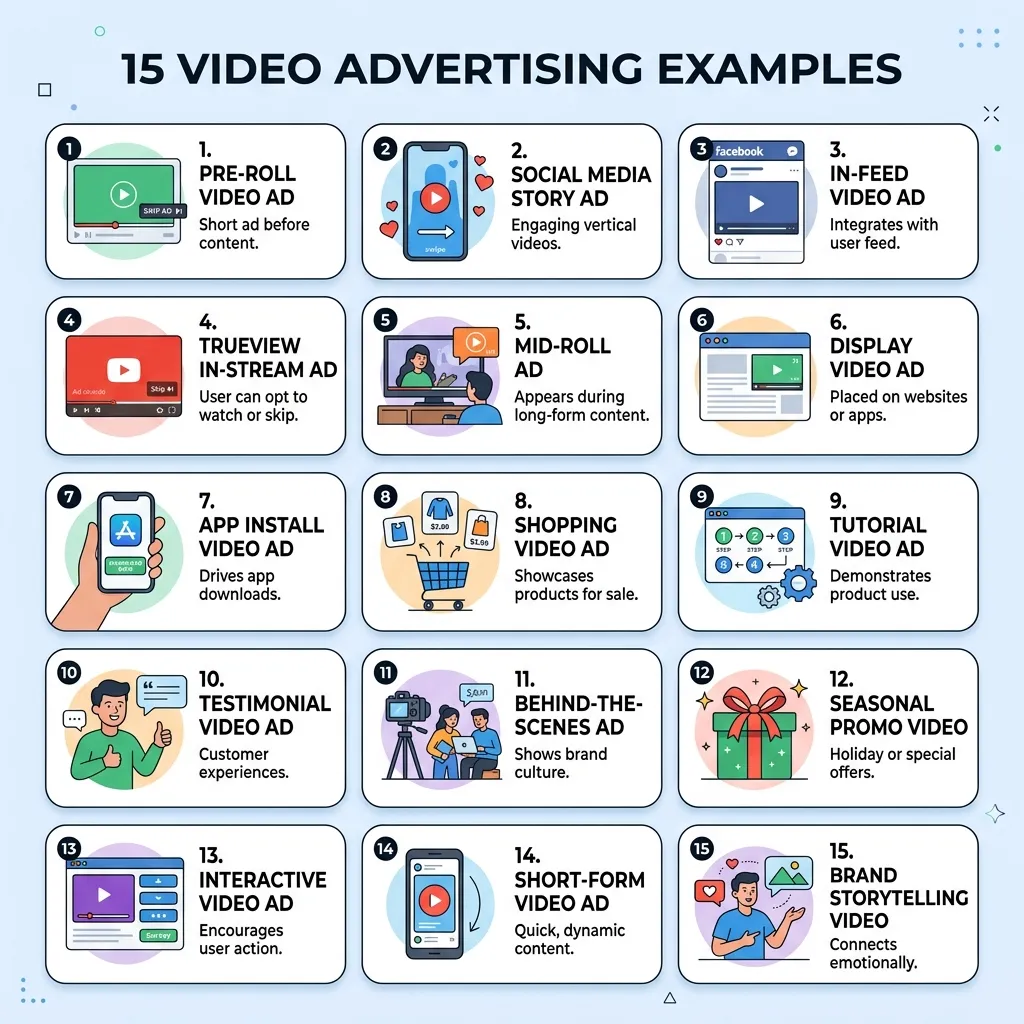
15 Video Advertising Examples
1. Product Demonstration Video Ads
Product demonstration ads show the product in action.
This is particularly useful for products whose benefits are easier to understand visually than through written descriptions.
For example, a software company could show how a user completes a task in three steps. A kitchen appliance brand could demonstrate how quickly a product prepares food.
The key is to focus on the customer outcome, not simply list features.
Instead of saying that a product has ten functions, demonstrate how those functions make the customer’s life easier.
2. Problem-Solution Video Ads
Problem-solution advertising begins with a problem that the target audience recognizes.
The advertisement then introduces the product or service as the solution.
A simple structure might look like:
Problem → Frustration → Solution → Benefit → CTA
For example, a productivity software advertisement could begin with an employee struggling with spreadsheets, emails, and disconnected tools. The video then shows how one platform simplifies the workflow.
This format works because viewers can immediately recognize the situation.
3. Customer Testimonial Video Ads
Customer testimonials use real experiences to build credibility.
Instead of allowing the brand to make every claim, the advertisement allows customers to explain what changed after using the product.
A strong testimonial should feel natural rather than heavily scripted.
The customer might explain:
- What problem they experienced
- Why they searched for a solution
- Why they selected the product
- What results they experienced
- Why they would recommend it
Customer-focused storytelling can make an advertisement more relatable and persuasive.
4. User-Generated Content Video Ads
User-generated content, or UGC, has become especially useful for social advertising.
The advertisement may look like an ordinary customer-created video rather than a traditional commercial.
A customer could unbox a product, demonstrate a feature, share an experience, or explain how they use a service.
This approach can make paid advertising feel more authentic.
User-generated videos can also provide businesses with a library of creative assets that can be tested across different campaigns.
For mobile brands, UGC can be particularly effective. App-focused campaigns can use short demonstrations, customer experiences, and authentic videos to encourage downloads. Research from AppMarketo also highlights video demos and UGC as useful formats for mobile app promotion.
5. Storytelling Video Advertisements
Storytelling ads connect a product with a larger narrative.
Instead of immediately discussing features, the advertisement introduces characters, challenges, emotions, or a transformation.
For example, a fitness brand might tell the story of someone who struggled with confidence before developing healthier habits.
The product becomes part of the journey rather than the entire story.
This approach is especially effective when brands want to build emotional connections rather than generate immediate transactions.
6. Before-and-After Video Ads
Before-and-after advertisements visually communicate transformation.
They can work well for:
- Beauty products
- Fitness services
- Home improvement
- Cleaning products
- Software
- Education
- Business services
The “before” state establishes the problem while the “after” state demonstrates the potential result.
The transformation needs to be credible and clearly explained. Misleading visual manipulation can damage trust, so brands should ensure that claims and demonstrations accurately represent the product.
7. Explainer Video Advertisements
Explainer advertisements are useful when the product or service requires some education.
A complex technology product, financial service, SaaS platform, or professional service may be difficult to communicate through a short traditional commercial.
An explainer video simplifies the concept through animation, screen recordings, narration, diagrams, or demonstrations.
The objective is not to explain every feature.
Instead, the advertisement should answer:
What is it? Who is it for? What problem does it solve? Why should I care?
For broader creative planning, marketers can also explore Types of Video Advertising to understand how different formats fit different campaign objectives.
8. Social Media Short-Form Video Ads
Short-form advertisements are designed for platforms where users quickly scroll through content.
The creative approach needs to be fast and visually engaging.
A strong short-form advertisement can:
- Start with an attention-grabbing moment.
- Introduce the problem.
- Demonstrate the solution.
- Present the key benefit.
- End with a simple CTA.
Vertical video is particularly useful for mobile-first environments.
Trend-based creative can also help brands increase attention. For example, TikTok-focused campaigns often benefit from authentic, native-feeling content rather than advertisements that look like traditional television commercials. TrendMarketo’s discussion of Viral Marketing on TikTok provides additional context on why authenticity and creative timing matter for short-form video campaigns.
9. Emotional Video Advertising
Emotion can make advertisements memorable.
Brands may use happiness, nostalgia, empathy, excitement, inspiration, surprise, or even humor to create stronger associations with their message.
However, emotion should support the brand purpose.
An emotional story that has no meaningful connection to the product may generate views without producing business results.
The strongest emotional advertisements connect the feeling directly to the brand’s value proposition.
10. Humor-Based Video Ads
Humor can help advertisements stand out in crowded feeds.
A funny situation, unexpected ending, exaggerated problem, or relatable customer experience can make people more likely to watch and share the content.
However, humor is highly dependent on audience and culture.
A joke that works for one demographic may be confusing or inappropriate for another.
Therefore, marketers should understand their audience before choosing comedy as the central creative concept.
11. Influencer Video Advertisements
Influencer advertisements combine creator credibility with paid promotion.
An influencer may demonstrate a product, review a service, share a personal experience, or integrate the product naturally into existing content.
This format can work particularly well when the influencer’s audience closely matches the advertiser’s target market.
The most effective influencer advertisements usually preserve some of the creator’s natural communication style instead of turning the video into a rigid corporate commercial.
AppMarketo’s research on Influencer Marketing for Mobile App Success also illustrates how video-based influencer content can combine trust, niche targeting, and product demonstrations.
12. Interactive Video Advertisements
Interactive video ads allow viewers to participate rather than simply watch.
Depending on the platform and campaign, interactive elements can include clickable choices, product selections, quizzes, forms, or direct shopping actions.
This can transform passive viewing into active engagement.
Interactive formats can be particularly useful when the advertiser wants to collect information, personalize the experience, or move viewers toward a specific conversion.
For more detailed ideas, see the Interactive Video Marketing Guide.
13. Retargeting Video Ads
Retargeting advertisements are shown to people who have already interacted with a business.
For example, someone might visit a product page but leave without purchasing.
A retargeting video could remind them of the product, demonstrate an important feature, answer a common objection, or highlight customer reviews.
Because the viewer already knows something about the brand, the advertisement can be more specific than an awareness campaign.
Retargeting can therefore move people further down the customer journey instead of repeating introductory information.
14. Educational Video Ads
Educational advertisements provide useful information while introducing a product or service.
For example, a cybersecurity company could explain how a common security problem occurs before showing how its software helps prevent it.
A financial brand could explain an important concept and then introduce its service.
This approach is particularly useful for industries where customers need information before making a purchase decision.
The advertisement becomes valuable even before the viewer converts.
15. App Install Video Ads
App install advertisements are designed specifically to encourage downloads.
Instead of explaining every feature, the video should quickly communicate the app’s core value.
A strong structure might be:
Problem → App solution → Product demonstration → Benefit → Download CTA
For example, a food delivery app might show someone struggling to decide what to eat, then demonstrate how the app finds nearby restaurants and completes an order within seconds.
Mobile app marketers can combine video ads with broader acquisition strategies such as paid social campaigns, ASO, influencer partnerships, and lifecycle marketing.
Video Advertising Examples by Marketing Goal

Different advertising objectives require different creative approaches.
Brand Awareness
For awareness campaigns, storytelling, humor, emotional content, influencer videos, and visually distinctive short-form advertisements can work well.
The objective is to make the brand memorable.
Lead Generation
Lead-generation advertisements should provide a reason for viewers to submit information.
Educational videos, webinars, demonstrations, and problem-solution advertisements can work well here.
The CTA might encourage viewers to download a resource, request a consultation, or register for an event.
Product Sales
Sales-focused campaigns can use product demonstrations, testimonials, UGC, before-and-after content, and retargeting videos.
These formats help reduce uncertainty and demonstrate value.
App Downloads
App install campaigns should quickly demonstrate the product experience.
Short demos, UGC, influencer videos, and feature-focused advertisements are particularly useful.
Customer Retention
Video advertising does not have to target new customers.
Existing customers can receive videos explaining advanced features, new products, loyalty benefits, or complementary services.
How to Create Your Own Video Advertising Example
Creating an effective video advertisement starts with the audience rather than the camera.
Step 1: Identify the Audience
Define who you want to reach.
Understand their needs, problems, interests, objections, and preferred platforms.
Step 2: Choose One Marketing Objective
Decide whether the campaign is designed for awareness, engagement, leads, sales, downloads, or retention.
One advertisement should have one primary objective.
Step 3: Select the Right Creative Format
Match the creative concept to the objective.
For example, use testimonials for trust, demonstrations for product education, and UGC for authenticity.
Step 4: Write the Core Message
Define the main point in one sentence.
If the message cannot be explained simply, the video may be trying to accomplish too much.
Step 5: Build the Storyboard
Plan the visual sequence before production.
Think about what viewers should see, hear, and understand at each stage.
Step 6: Add the CTA
Tell viewers exactly what to do next.
Avoid multiple competing CTAs unless there is a strong strategic reason.
Step 7: Test Multiple Versions
Create variations of the hook, opening visual, length, CTA, headline, and creative style.
Testing allows performance data to determine which concept works best.
Common Mistakes to Avoid in Video Advertising
Starting Too Slowly
A long introduction can lose viewers before the main message appears.
Get to the value quickly.
Making the Advertisement About the Brand
Customers generally care more about their own problems than about a company’s history.
Lead with the audience’s needs.
Overloading the Video
Too much text, too many features, and multiple competing messages can make the advertisement difficult to understand.
Keep the central message focused.
Ignoring Mobile Viewing
Many audiences encounter advertisements on smartphones.
Videos should therefore remain understandable on smaller screens, with readable text and clear visuals.
Weak Calls to Action
A good video without a clear next step can waste valuable attention.
Make the desired action obvious.
Focusing Only on Views
Views are useful, but they are not always the ultimate goal.
Depending on the campaign, marketers may need to evaluate watch time, engagement, clicks, conversions, cost per acquisition, revenue, or return on advertising spend.
For a broader understanding of measurement, see Video Marketing Metrics.
How to Measure Video Advertising Performance
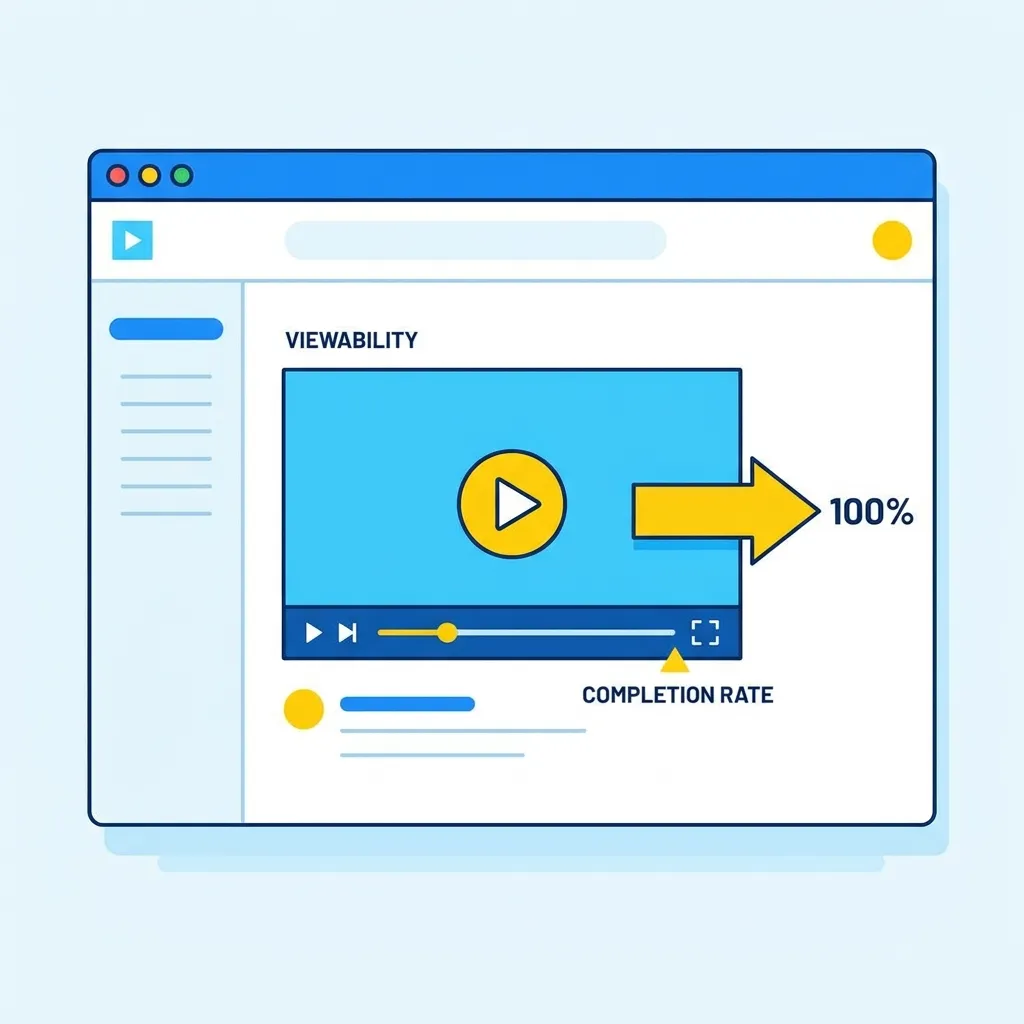
The right metrics depend on the campaign objective.
View and Reach Metrics
These include impressions, reach, views, and video completion.
They help marketers understand how effectively the advertisement attracts and retains attention.
Engagement Metrics
Engagement can include likes, comments, shares, saves, clicks, and other interactions.
These metrics help identify whether viewers are responding to the creative.
Conversion Metrics
Conversion-focused campaigns should monitor actions such as purchases, registrations, downloads, leads, and bookings.
Financial Metrics
Businesses should also consider cost per acquisition, customer acquisition cost, revenue generated, and return on advertising spend.
A video with fewer views can sometimes outperform a viral video if it generates substantially more qualified customers.
Conclusion
Studying video advertising examples is one of the easiest ways for marketers to discover new creative approaches.
Product demonstrations, testimonials, UGC, storytelling, humor, influencer campaigns, interactive advertisements, educational videos, retargeting campaigns, and app-install ads can all serve different marketing objectives.
The most important step is not copying another company’s advertisement. Instead, identify the principle behind the creative idea and adapt it to your own audience.
A successful video advertisement should attract attention, communicate a clear benefit, build interest, and guide the viewer toward an appropriate action.
When creative quality, audience targeting, distribution, and measurement work together, video advertising can become a powerful engine for awareness, engagement, leads, sales, and long-term brand growth.
Frequently Asked Questions
1. What are video advertising examples?
Video advertising examples are real or practical examples of promotional videos used to achieve goals such as brand awareness, engagement, lead generation, sales, app downloads, or customer retention.
2. What is the most effective type of video advertisement?
There is no single format that works for every business. Product demonstrations, testimonials, UGC, storytelling, and problem-solution videos can all be effective when matched with the right audience and objective.
3. Why are video advertisements effective?
Video combines visual storytelling, audio, text, demonstrations, and emotion, allowing brands to communicate information quickly while creating memorable experiences.
4. What makes a good video advertisement?
A good video advertisement has a strong opening, clear message, relevant visuals, audience-focused value, appropriate length, and a specific call to action.
5. How long should a video advertisement be?
The ideal length depends on the platform, audience, message, and campaign objective. Shorter videos are often useful for social feeds, while complex products may require longer demonstrations or explainers.
6. Are UGC video ads effective?
UGC can be highly effective because it can make advertising feel more authentic and relatable. Customer demonstrations, reviews, testimonials, and experience-based videos are common UGC formats.
7. What is a product demonstration video ad?
A product demonstration video shows how a product or service works and focuses on its practical benefits. It is especially useful when customers need to see the product before understanding its value.
8. What type of video ad is best for brand awareness?
Storytelling, emotional advertisements, influencer content, humor, and visually distinctive short-form videos can be effective for building brand awareness.
9. What video ads work well for lead generation?
Educational videos, webinars, product demonstrations, problem-solution advertisements, and expert-led explainers can work well for lead generation because they provide value before asking viewers to convert.
10. How can businesses improve video advertising performance?
Businesses can improve performance by strengthening the opening hook, simplifying the message, improving targeting, testing different creatives, optimizing CTAs, and analyzing conversion data.
11. Should video advertisements be optimized for mobile?
Yes. Many viewers encounter video advertisements on mobile devices, so businesses should consider vertical formats, readable text, strong visual openings, and clear messaging on smaller screens.
12. How do you measure the success of a video advertisement?
Measure performance based on the campaign objective. Useful metrics can include reach, views, completion rate, engagement, click-through rate, conversions, cost per acquisition, revenue, and return on advertising spend.