Online video advertising is a digital marketing method that uses video content to promote products, services, brands, or offers across platforms such as YouTube, social media, websites, streaming services, and search networks. With the right targeting, creative strategy, placement, and performance tracking, online video advertising can increase brand awareness, engagement, website traffic, leads, and conversions.
Video has become one of the most powerful formats in digital marketing because it combines visuals, sound, storytelling, and movement into one communication channel. Businesses of all sizes can use video to explain products, demonstrate services, educate audiences, build trust, and encourage customers to take action.
Online video advertising takes this concept further by placing promotional video content in digital environments where audiences already spend time. Instead of relying only on traditional television advertising, brands can reach specific audiences through platforms such as YouTube, social networks, websites, mobile apps, connected TV services, and other digital channels.
One of the biggest advantages of online video advertising is targeting. Advertisers can often reach audiences based on demographics, interests, behaviors, search intent, location, device usage, and previous interactions with a brand.
However, simply creating a video and paying to promote it does not guarantee results. Successful campaigns require a clear objective, strong creative content, accurate audience targeting, appropriate placement, effective calls to action, and continuous optimization.
This guide explains how online video advertising works, the major types, benefits, costs, strategies, metrics, mistakes, and best practices businesses can use to build more effective campaigns.
What Is Online Video Advertising?
Online video advertising is the practice of promoting a brand, product, service, or message through paid video placements on digital platforms.
These advertisements can appear before, during, or after online video content. They can also appear within social media feeds, websites, mobile applications, search results, and streaming environments.
Common examples include:
- YouTube video ads
- Social media video ads
- In-stream advertisements
- Outstream video ads
- Short-form video advertisements
- Connected TV advertising
- Video display advertising
- Shoppable video ads
- Mobile video advertising
- Sponsored video content
Unlike traditional advertising, digital video campaigns can use audience data and performance analytics to make targeting and optimization more precise.
How Does Online Video Advertising Work?

The basic process involves several important stages.
1. Define the Campaign Objective
First, determine what the campaign should accomplish.
Common objectives include:
- Brand awareness
- Website traffic
- Lead generation
- Product sales
- App installations
- Customer engagement
- Retargeting
- Product education
A campaign designed for awareness may prioritize video views and reach, while a conversion campaign may focus on clicks, leads, or purchases.
2. Identify the Target Audience
Advertisers define who should see the video.
Targeting may include:
- Age
- Gender
- Location
- Interests
- Search behavior
- Online activity
- Device
- Previous website visits
- Customer lists
- Purchasing behavior
The more clearly an audience is defined, the easier it becomes to create relevant messaging.
3. Create the Video Advertisement
The creative should communicate the core message quickly.
A strong video advertisement usually includes:
Hook → Problem → Solution → Benefit → Call to Action
The opening seconds are particularly important because viewers can quickly lose interest or skip an advertisement.
4. Select Platforms and Placements
The advertiser chooses where the video should appear.
For example, a business targeting younger consumers might prioritize short-form social platforms, while a B2B company may focus more heavily on professional audiences and YouTube.
5. Launch and Monitor
After launch, advertisers monitor campaign performance and identify what is working.
Important performance indicators include:
- Impressions
- Views
- View rate
- Watch time
- Click-through rate
- Conversion rate
- Cost per view
- Cost per acquisition
- Return on ad spend
6. Optimize the Campaign
Campaign data can be used to adjust:
- Audience targeting
- Budget allocation
- Video creative
- Ad placement
- Frequency
- Bidding
- Calls to action
Optimization should continue throughout the campaign rather than waiting until the end.
Types of Online Video Advertising
Different video ad formats serve different marketing objectives.
In-Stream Video Ads
In-stream ads appear within video content.
They may play before, during, or after the main video.
These ads are useful for businesses that want to reach users while they are already consuming video content.
Outstream Video Ads
Outstream ads appear outside traditional video players, often within websites or mobile content.
They can automatically begin playing when they become visible on the user’s screen.
Social Media Video Ads
Social platforms provide highly engaging environments for video advertising.
Businesses can use video advertisements to:
- Introduce products
- Promote offers
- Build awareness
- Generate leads
- Drive website traffic
- Retarget previous visitors
Short-Form Video Ads
Short-form video has become an important advertising format because users often consume quick, mobile-friendly content.
Successful short-form advertisements typically use:
- Fast hooks
- Captions
- Strong visuals
- Simple messaging
- Quick transitions
- Clear calls to action
Connected TV and Streaming Ads
Connected TV advertising allows brands to reach audiences watching digital streaming content through internet-connected televisions and devices.
This creates an opportunity to combine television-style storytelling with digital targeting and measurement.
Shoppable Video Ads
Shoppable video advertisements connect promotional content with purchasing opportunities.
Viewers may be able to click on products, visit product pages, or complete other commercial actions directly from the experience.
Benefits of Online Video Advertising
Increased Brand Awareness
Video allows brands to communicate visual identity, messaging, personality, and value propositions quickly.
A memorable video can help consumers recognize and remember a brand.
Stronger Audience Engagement
Video combines multiple communication elements, making it easier to demonstrate concepts and capture attention than text alone.
Better Targeting
Digital platforms can provide sophisticated audience targeting capabilities.
Businesses can focus their campaigns on audiences that are more likely to be interested in their products or services.
Higher Message Retention
Visual storytelling can make complex concepts easier to understand and remember.
This is particularly useful for products that require demonstrations or explanations.
Measurable Performance
Unlike many traditional advertising channels, online video advertising provides detailed performance data.
Advertisers can monitor campaign performance and make changes based on actual results.
Supports the Customer Journey
Video can be used at multiple stages of the marketing funnel.
For example:
Awareness: Brand introduction
Consideration: Product explanation
Decision: Testimonial or demonstration
Conversion: Promotional offer
Retention: Customer education
Online Video Advertising vs. Traditional Video Advertising
| Factor | Online Video Advertising | Traditional TV Advertising |
|---|---|---|
| Targeting | Highly specific | Generally broader |
| Measurement | Detailed digital metrics | Often based on audience estimates |
| Flexibility | High | Comparatively limited |
| Budget options | Flexible | Often requires larger commitments |
| Optimization | Real-time adjustments | Less immediate |
| Platforms | Websites, apps, social, streaming | Television networks |
| Personalization | Strong potential | Limited |
| Engagement tracking | Extensive | More limited |
Both approaches can work effectively. The right choice depends on the audience, campaign objective, budget, and overall marketing strategy.
How to Create an Effective Online Video Advertising Strategy

Start With a Clear Objective
Avoid creating a campaign simply because video is popular.
Determine exactly what you want to achieve.
For example:
“Generate 500 qualified leads in three months.”
A specific objective makes campaign measurement much easier.
Understand Audience Intent
Knowing what customers want is more important than simply knowing their demographics.
Consider:
- What problem are they trying to solve?
- What questions do they ask?
- What objections prevent them from buying?
- What information do they need?
- What motivates their purchase?
This information can guide the video’s message.
Create a Strong Hook
The beginning of the advertisement should immediately give viewers a reason to continue watching.
Effective hooks can include:
- A question
- A surprising fact
- A problem
- A bold statement
- A product demonstration
- A relatable situation
Keep the Message Focused
Do not try to communicate every product feature in one advertisement.
Focus on one primary message.
For example:
Problem: Small businesses struggle with repetitive marketing tasks.
Solution: Automated workflows reduce manual work.
Benefit: Teams save time and improve customer follow-up.
CTA: Learn more.
Include a Clear Call to Action
Every performance-focused video should tell viewers what to do next.
Examples include:
- Shop now
- Learn more
- Get started
- Book a demo
- Download the guide
- Sign up today
- Request a quote
The Role of Personalization in Online Video Advertising
Personalization can make video advertising more relevant to different audience segments.
Instead of showing the same message to everyone, advertisers can create variations based on:
- Audience interests
- Location
- Customer stage
- Previous interactions
- Product preferences
- Purchase behavior
For example, someone who has already visited a product page may receive a different video advertisement from someone who has never interacted with the brand.
Businesses interested in combining automation and personalization can also explore this related resource on Marketing Automation for Small Business.
Online Video Advertising and Retargeting
Retargeting allows businesses to reach people who have previously interacted with their brand.
A visitor may:
- Watch a product video.
- Visit the website.
- Leave without purchasing.
- Later see a retargeting video.
- Return to the website.
- Complete the purchase.
This approach can be particularly useful because the audience has already demonstrated some level of interest.
Retargeting campaigns can be built around actions such as:
- Website visits
- Product-page views
- Video engagement
- Cart abandonment
- Previous purchases
- Form submissions
Online Video Advertising for Small Businesses
Small businesses do not necessarily need large advertising budgets to benefit from video.
They can begin with focused campaigns targeting a narrow audience.
Start With One Platform
Rather than spreading a small budget across multiple platforms, start with the channel where the target audience is most active.
Repurpose Existing Content
A business can transform:
- Product demonstrations
- Customer testimonials
- Tutorials
- FAQs
- Blog content
- Behind-the-scenes footage
into advertising creatives.
Test Multiple Creatives
Create several versions of an advertisement and compare performance.
Test variables such as:
- Opening hook
- Video length
- Thumbnail
- Headline
- CTA
- Voiceover
- Visual style
Focus on Business Outcomes
Views are useful, but they are not always the final objective.
Small businesses should connect video performance to:
- Leads
- Sales
- Bookings
- Signups
- Revenue
Online Video Advertising Costs
The cost of online video advertising varies based on several factors.
These include:
- Platform
- Audience size
- Targeting criteria
- Competition
- Campaign objective
- Ad format
- Geographic market
- Bidding strategy
- Video quality
- Campaign duration
Some campaigns can begin with relatively small daily budgets, while large national campaigns may require significantly more investment.
The cost of producing the video itself should also be considered.
For a broader understanding of advertising expenses, businesses can review this related video advertising cost guide.
Key Metrics for Online Video Advertising
Tracking the right metrics is essential.
Impressions
Impressions represent how many times the advertisement was displayed.
Video Views
Views indicate how many times users watched the advertisement according to the platform’s view definition.
View Rate
View rate measures the percentage of impressions that resulted in views.
Watch Time
Watch time indicates how long viewers engaged with the video.
Click-Through Rate
CTR measures how frequently viewers clicked after seeing the advertisement.
Conversion Rate
Conversion rate measures the percentage of users who completed the desired action.
Cost Per Acquisition
CPA measures the average cost of generating a desired conversion.
Return on Ad Spend
ROAS compares advertising revenue with advertising expenditure.
For businesses focused heavily on measurement, a detailed resource on video marketing metrics can help with campaign evaluation.
Common Online Video Advertising Mistakes
Creating Ads Without a Strategy
A visually impressive video can still fail if it does not have a clear marketing objective.
Weak Opening
If the advertisement takes too long to explain its purpose, viewers may leave before reaching the main message.
Ignoring Mobile Viewers
Many online videos are consumed on mobile devices. Advertisements should be designed for smaller screens.
Using Too Much Text
Overloading a video with text can make it difficult to watch.
Keep on-screen messaging concise and readable.
Poor Targeting
Even an excellent advertisement will struggle if it reaches the wrong audience.
No Clear CTA
Viewers should understand what action they should take after watching.
Measuring Only Views
High view counts do not necessarily mean high business value.
Always connect campaign metrics with the actual objective.
Online Video Advertising Best Practices
Follow these practices to improve campaign performance:
- Define a measurable objective.
- Research the target audience.
- Create a strong opening hook.
- Keep the message focused.
- Design for mobile viewing.
- Use captions when appropriate.
- Show the product or solution clearly.
- Maintain consistent brand identity.
- Include a strong CTA.
- Test multiple creative variations.
- Use audience segmentation.
- Retarget engaged users.
- Monitor campaign performance.
- Optimize based on conversion data.
- Refresh advertisements when performance declines.
How AI Is Changing Online Video Advertising
Artificial intelligence is increasingly influencing video advertising workflows.
AI-powered tools can assist with:
- Audience analysis
- Creative variations
- Video editing
- Script generation
- Personalization
- Predictive analytics
- Campaign optimization
- Performance forecasting
AI can help marketers work faster, but human strategy remains essential.
Businesses still need to understand their audience, define the brand message, review creative quality, and ensure that advertisements are accurate and appropriate.
For a broader perspective on automated marketing strategy, see this complete marketing automation strategy guide.
How to Improve Online Video Advertising Performance
Improving campaign performance is an ongoing process.
Test Your Creative
Do not assume the first video will be the best performer.
Test multiple hooks, messages, lengths, and CTAs.
Analyze Audience Behavior
Look for patterns in:
- Watch time
- Drop-off points
- Clicks
- Conversions
- Repeat engagement
Optimize Budget Allocation
Move more budget toward audiences, placements, and creatives that produce stronger results.
Refresh Underperforming Ads
Audience fatigue can reduce performance over time.
Create fresh variations when engagement begins to decline.
Connect Video With Other Marketing Channels
Video advertising becomes more powerful when integrated with:
- Search marketing
- Email marketing
- Social media
- Content marketing
- SEO
- Marketing automation
- Retargeting
A connected strategy allows users to encounter consistent messaging across multiple touchpoints.
Online Video Advertising Funnel
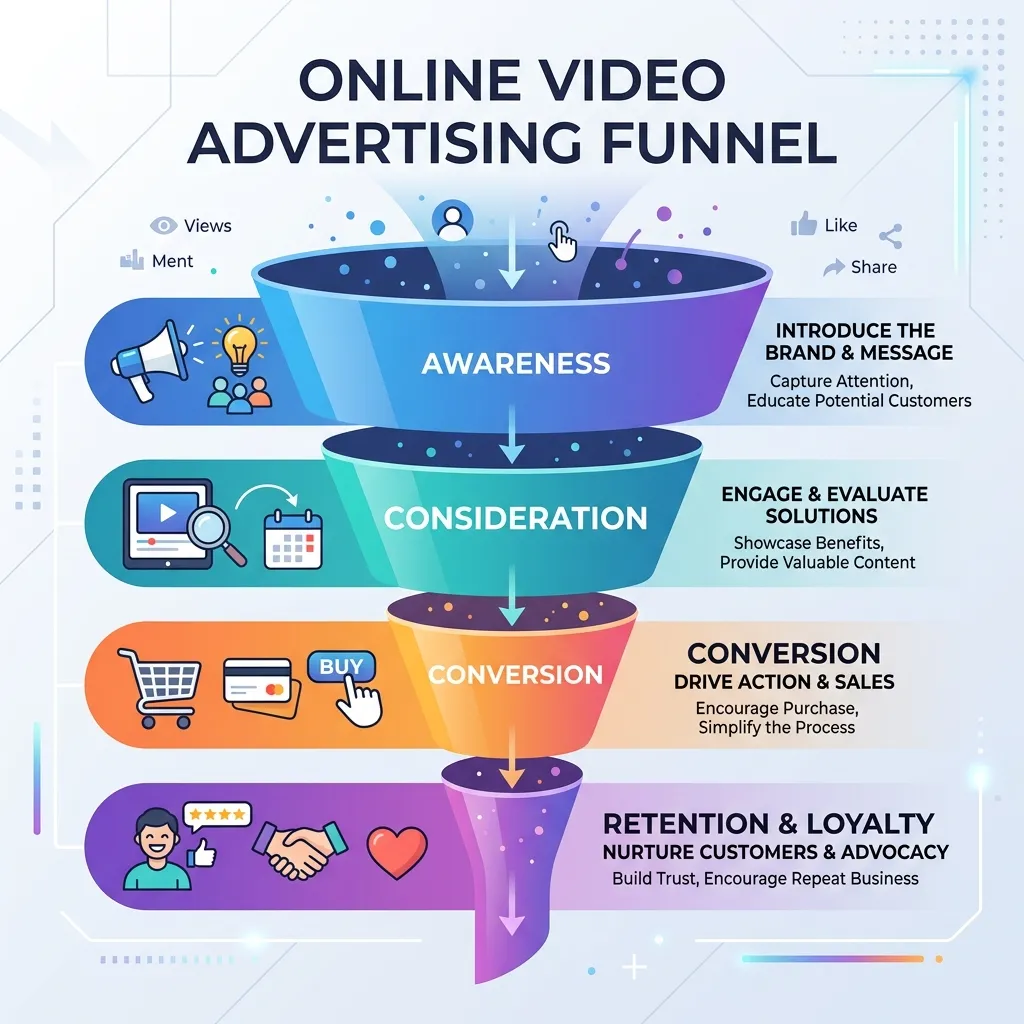
A simple video advertising funnel can look like this:
Awareness Stage
Use short, engaging videos to introduce the brand.
Goal: Reach and awareness.
Consideration Stage
Provide educational videos, product explanations, comparisons, or demonstrations.
Goal: Engagement and website traffic.
Conversion Stage
Use testimonials, product benefits, offers, and strong CTAs.
Goal: Leads or sales.
Retention Stage
Use educational or customer-focused videos after conversion.
Goal: Customer satisfaction and repeat business.
Future of Online Video Advertising
Online video advertising will continue evolving as consumer behavior, technology, and advertising platforms change.
Several developments are likely to remain important:
- AI-powered creative optimization
- Personalized video experiences
- Interactive advertisements
- Shoppable video
- Connected TV advertising
- Short-form video
- First-party data strategies
- Advanced audience segmentation
- Cross-platform measurement
- Automated campaign optimization
Businesses that combine strong creative storytelling with data-driven optimization will be better positioned to compete for audience attention.
Conclusion
Online video advertising gives businesses a powerful way to reach targeted audiences, communicate products visually, build awareness, generate leads, and drive conversions. Its biggest advantage is the combination of engaging video content with digital targeting and measurable performance.
Successful campaigns start with a clear objective and audience strategy. From there, businesses need to create compelling videos, choose suitable platforms, use strong calls to action, and continuously analyze performance.
Small businesses can start with focused campaigns and gradually expand as they learn what works. By combining video advertising with retargeting, personalization, marketing automation, and other digital channels, brands can create a more connected customer journey.
Ultimately, effective online video advertising is not simply about getting more views. It is about reaching the right audience with the right message and turning attention into meaningful business results.
Frequently Asked Questions
1. What is online video advertising?
Online video advertising is the use of paid promotional videos across digital platforms such as YouTube, social media, websites, mobile applications, and streaming services.
2. How does online video advertising work?
Advertisers create video content, define a target audience, choose advertising platforms and placements, set a budget, launch the campaign, and monitor performance through digital analytics.
3. What are the main types of online video advertising?
Common types include in-stream ads, outstream ads, social media video ads, short-form video ads, connected TV ads, mobile video ads, and shoppable video advertisements.
4. Is online video advertising effective?
It can be highly effective when the campaign has strong creative content, accurate targeting, a clear objective, and continuous optimization.
5. How much does online video advertising cost?
Costs vary depending on the platform, audience, competition, targeting, campaign objective, geographic market, and bidding strategy. Video production costs should also be included in the overall budget.
6. What platforms are used for online video advertising?
Popular environments include YouTube, social media platforms, websites, mobile apps, streaming services, and connected TV platforms.
7. What makes a good online video advertisement?
A strong video advertisement usually has an engaging hook, clear messaging, compelling visuals, a relevant audience, strong branding, and a clear call to action.
8. How long should an online video advertisement be?
There is no universal ideal length. The appropriate length depends on the platform, audience, campaign objective, and complexity of the message. The key is to communicate the main value quickly.
9. Can small businesses use online video advertising?
Yes. Small businesses can start with focused audiences, smaller budgets, short-form videos, and a single platform before expanding their campaigns.
10. What metrics should I track?
Important metrics include impressions, views, view rate, watch time, click-through rate, conversions, cost per acquisition, and return on ad spend.
11. What is video advertising retargeting?
Video retargeting involves showing advertisements to users who have previously interacted with a brand, such as visiting a website, watching a video, viewing a product, or abandoning a purchase.
12. How can AI improve online video advertising?
AI can assist with audience analysis, creative variations, personalization, editing, predictive analytics, and campaign optimization. Human oversight remains important for strategy and creative quality.