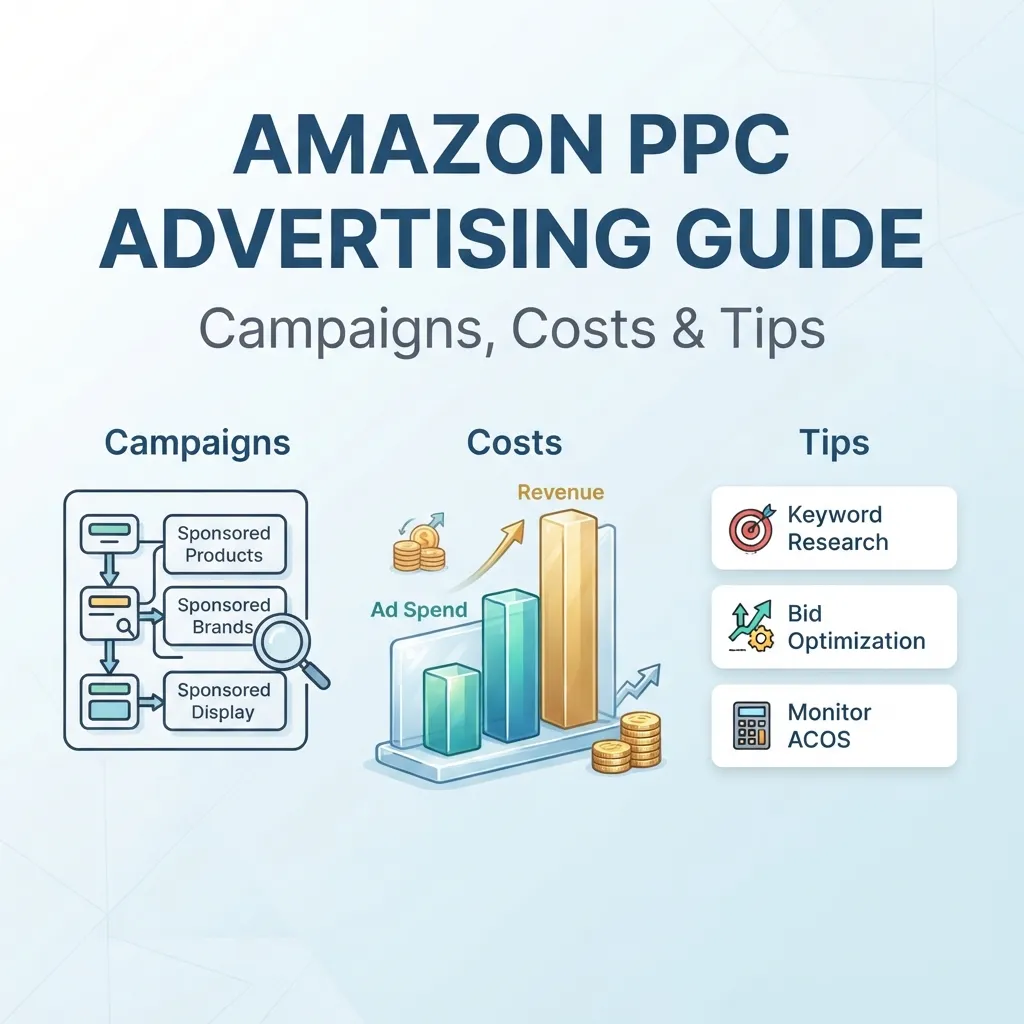
This Amazon PPC advertising guide breaks down the campaign types available to sellers, how bidding and budgets actually work, the metrics that matter most, and the optimization habits that separate profitable campaigns from ones that quietly bleed ad spend without returning much in sales.
Amazon has become a search engine and a storefront at the same time, and for most sellers, visibility on that search page is no longer something that happens organically alone. Paid placement through Amazon’s advertising platform is now a standard cost of doing business for anyone selling on the marketplace, which makes understanding how the system actually works essential rather than optional.
This Amazon PPC advertising guide walks through the core campaign types, how the auction and bidding system functions, the metrics sellers need to track, and the optimization tactics that consistently separate profitable campaigns from wasted spend. Whether launching a first campaign or trying to fix an underperforming account, the fundamentals covered here apply across most product categories and account sizes.
How Amazon PPC Actually Works
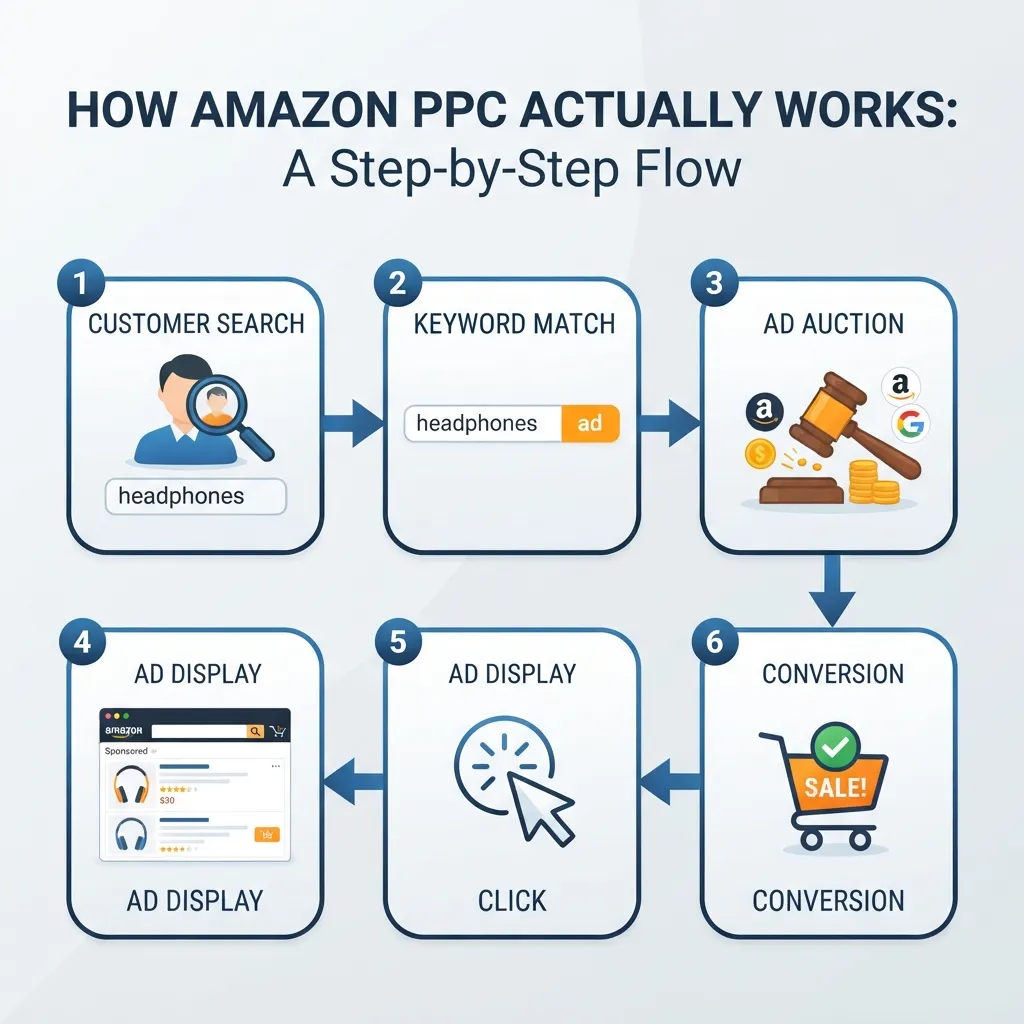
Understanding how Amazon PPC actually works is the foundation of this entire Amazon PPC advertising guide. It operates on an auction model similar in principle to other paid search platforms. Sellers bid on keywords or product targets, and when a shopper’s search or browsing behavior matches those targets, an auction runs among eligible ads. The winner isn’t necessarily the highest bidder — Amazon’s algorithm also weighs relevance and expected performance, meaning a well-optimized, relevant ad can outcompete a higher bid with weaker targeting.
As this Amazon PPC advertising guide covers throughout, cost is charged per click rather than per impression, which means an ad can appear frequently without generating cost unless someone actually clicks it. This makes visibility relatively low-risk compared to formats charged per impression, but it also means poor conversion after the click — a weak product listing, uncompetitive pricing, thin reviews — can still drain budget without producing sales.
Amazon PPC Campaign Types
Sponsored Products
This is the most commonly used campaign type covered in any Amazon PPC advertising guide and the typical starting point for new sellers. Sponsored Products ads appear within search results and on product detail pages, promoting individual listings. They support both keyword targeting, where sellers bid on specific search terms, and product targeting, where ads are shown on or near competitor listings and related products.
Sponsored Brands
Sponsored Brands ads appear at the top of search results and showcase a brand logo, a custom headline, and multiple products rather than a single listing. These campaigns require brand registry and work well for building awareness across a product catalog rather than driving traffic to a single item. Sponsored Brands also support video creative, which functions similarly to other forms of video advertising in that it needs to capture attention within the first few seconds to be effective within a crowded feed.
Sponsored Display
Sponsored Display ads can appear both on and off Amazon, retargeting shoppers who viewed a product but didn’t purchase, or reaching audiences based on interest and shopping behavior. This format is particularly useful for recovering abandoned consideration further down the funnel, complementing the awareness-stage exposure that Sponsored Products and Sponsored Brands campaigns typically generate.
Video Ads Within Amazon PPC
Video creative has become an increasingly prominent part of Amazon’s advertising options, appearing within Sponsored Brands campaigns and in standalone video placements. The same principles that apply to video advertising strategy elsewhere — a strong opening hook, a clear value proposition, and a concise runtime — apply directly here, since Amazon shoppers scroll quickly and have little patience for a slow-building narrative.
Key Metrics in This Amazon PPC Advertising Guide
Any credible Amazon PPC advertising guide has to center on a handful of metrics that determine whether a campaign is actually working, since metrics are what separate a working Amazon PPC advertising guide from theory alone.
- ACOS (Advertising Cost of Sale) — ad spend divided by attributed sales, expressed as a percentage; the core profitability metric most sellers track
- TACOS (Total Advertising Cost of Sale) — ad spend as a percentage of total sales, including organic, which shows how much of overall revenue is being supported by paid spend
- CTR (Click-Through Rate) — how often an ad is clicked relative to how often it’s shown, an early signal of listing relevance and creative appeal
- Conversion rate — the percentage of clicks that result in a purchase, heavily influenced by listing quality, pricing, and reviews
- CPC (Cost Per Click) — the average amount paid per click, which varies significantly by category competitiveness
- Impression share — how often an ad appears relative to the total available opportunities for its targeting, useful for understanding whether budget or bid limits are capping visibility
ACOS is the number most sellers fixate on in any Amazon PPC advertising guide, but it’s worth interpreting relative to product margin rather than as an absolute target. A 30% ACOS might be unprofitable for a low-margin product and perfectly healthy for a high-margin one, so the right target varies by listing rather than following a single rule of thumb.
Building a Bidding Strategy
Bidding is where much of this Amazon PPC advertising guide becomes actionable — it involves a few structural decisions that shape how a campaign performs from the start.
Manual versus automatic targeting. Automatic campaigns let Amazon’s algorithm select relevant keywords and placements, which works well for gathering initial data on a new listing. Manual campaigns give sellers direct control over which keywords or products to target, which becomes more valuable once enough data exists to know which terms actually convert.
Bid adjustments by placement. Amazon allows different bid multipliers for top-of-search placement versus product page placement, since these positions typically convert at different rates. Increasing bids for placements that historically convert well, while reducing them for underperforming placements, is one of the more reliable optimization levers available.
Dayparting and budget pacing. Some sellers adjust bids or budgets based on time of day or day of week, particularly in categories with predictable shopping patterns. This requires enough sales volume to identify meaningful patterns, so it’s generally more relevant for established listings than brand-new ones.
Negative keywords. Excluding irrelevant search terms that trigger clicks without converting is one of the simplest ways to reduce wasted spend, particularly in automatic campaigns where the algorithm sometimes matches broader terms than intended.
Structuring Campaigns for Long-Term Performance
One point worth repeating throughout this Amazon PPC advertising guide: a common mistake is running every product through a single, undifferentiated campaign structure. A more durable approach separates campaigns by intent and maturity:
- Discovery campaigns — typically automatic or broad-match manual campaigns used to identify which search terms actually convert for a new or underperforming listing
- Harvested keyword campaigns — exact-match campaigns built from the terms that proved profitable during the discovery phase, usually with tighter bid control
- Defense campaigns — targeting a brand’s own product terms to prevent competitors from winning that traffic, and sometimes targeting competitor terms directly through product targeting
- Brand awareness campaigns — Sponsored Brands and Sponsored Display campaigns aimed at broader visibility rather than immediate conversion
This structure allows a seller to see clearly where budget is being spent for discovery purposes versus proven performance, which makes it much easier to diagnose why overall ACOS might be rising even when individual keyword performance looks stable.
Common Mistakes in Amazon PPC Campaigns
Setting ACOS targets without accounting for margin. A flat ACOS goal applied across an entire catalog ignores that different products can sustain very different advertising costs profitably.
Neglecting the listing itself. No amount of PPC optimization compensates for a weak product listing — poor images, thin reviews, uncompetitive pricing. Traffic sent to a listing that doesn’t convert simply burns budget faster.
Over-relying on automatic campaigns indefinitely. Automatic campaigns are useful for discovery but tend to accumulate wasted spend on marginal search terms if never transitioned into more controlled manual structures.
Ignoring negative keywords. Skipping this step is one of the most common and easily fixed sources of wasted spend, particularly in competitive or broadly related categories.
Making bid changes too frequently. Adjusting bids daily based on short-term fluctuations often reacts to noise rather than genuine trends, since Amazon’s data typically needs several days to smooth out normal variance.
Ignoring seasonality. Campaigns optimized during a slow season may be underbid and lose visibility during peak periods, or vice versa, if budgets and bids aren’t reviewed ahead of predictable seasonal shifts.
Measuring Success Beyond ACOS
This Amazon PPC advertising guide would be incomplete without noting that, while ACOS remains the headline metric in most reporting, a complete view of Amazon PPC performance also considers organic rank improvement driven by paid visibility, since strong-converting campaigns often lift a listing’s organic search position over time. TACOS is particularly useful here, since a declining TACOS alongside stable or growing total sales suggests paid advertising is successfully building organic momentum rather than being the sole driver of revenue indefinitely.
Sellers who want a deeper technical breakdown of how conversion and engagement data get tracked and reported across a broader advertising program may also find value in a general video advertising cost comparison, since many Amazon sellers now split budget between on-platform PPC and off-platform video campaigns and benefit from comparing cost efficiency across both.
Long-term brand metrics matter too — repeat purchase rate, brand search volume, and review velocity all indicate whether PPC-driven traffic is converting into a durable customer base rather than one-time, price-sensitive purchases that disappear once ad spend stops.
How Amazon PPC Fits Into a Broader Advertising Mix
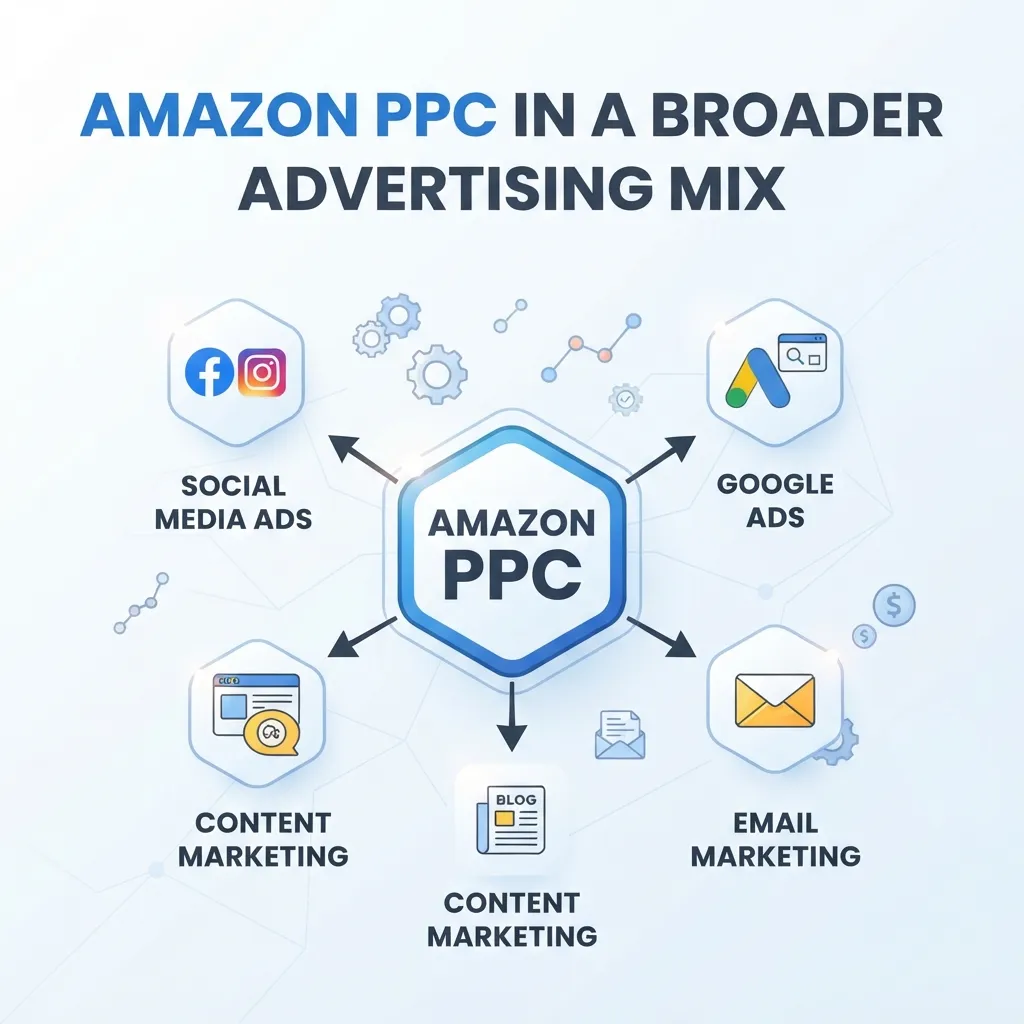
Most sellers running Amazon PPC are also managing some combination of external traffic, social content, and — for brand-registered sellers in particular — a growing library of video assets used across placements. The overlap with video marketing is worth calling out specifically in this Amazon PPC advertising guide, since Sponsored Brands video and standalone video placements increasingly compete for the same attention as any other short-form video a brand produces. Sellers who already have a video marketing campaign running elsewhere often find it efficient to repurpose or adapt existing creative for Amazon placements rather than producing entirely separate assets from scratch, provided the pacing and messaging are adjusted for Amazon’s faster-scrolling shopping context.
Ecommerce sellers evaluating their overall advertising approach also benefit from looking outside the platform itself for context on how paid and emotional or brand-driven marketing intersect. An outside resource on emotional marketing for ecommerce and retail brands is a useful companion read here, since Amazon PPC tends to excel at capturing existing demand but does relatively little to build the brand affinity that keeps customers returning without paid support. A related piece on predictive analytics for ROI strategy covers how sellers increasingly forecast which campaigns are likely to perform before committing significant budget, a discipline that applies directly to Amazon PPC bid planning during high-competition periods like major shopping events.
Treating Amazon PPC as one channel within a broader strategy, rather than the entire strategy, tends to produce more durable results. Paid search on Amazon captures shoppers who are already searching with purchase intent; it does comparatively little to create that intent in the first place, which is where off-platform brand building and content still play a meaningful role even for sellers whose revenue is concentrated on Amazon.
Conclusion
A useful Amazon PPC advertising guide comes down to a few consistent principles: match campaign type to the actual goal, keep bidding structured rather than reactive, track ACOS relative to margin rather than as a flat target, and never separate advertising performance from the underlying listing quality it’s supporting. That’s the core lesson of any practical Amazon PPC advertising guide: sellers who build campaigns around discovery, defense, and brand visibility — rather than a single undifferentiated structure — tend to see clearer data and more consistent profitability over time. As with most paid advertising, the platform rewards patience and structured testing far more than frequent, reactive bid changes.
Frequently Asked Questions (FAQs)
1. What is a good ACOS for Amazon PPC?
It depends heavily on product margin. A target that’s profitable for a high-margin product may be unsustainable for a low-margin one, so ACOS should be evaluated against each listing’s actual profitability rather than a single universal benchmark.
2. What’s the difference between Sponsored Products and Sponsored Brands?
Sponsored Products promote individual listings within search results and product pages, while Sponsored Brands showcase a brand logo and multiple products together, typically at the top of search results, and require brand registry.
3. Should new sellers start with automatic or manual campaigns?
Automatic campaigns are generally a good starting point for gathering keyword data on a new listing, with manual campaigns introduced once enough performance data exists to target proven terms directly.
4. How does Amazon’s ad auction determine which ad wins?
The auction weighs both bid amount and relevance or expected performance, meaning a highly relevant, well-optimized ad can outperform a higher bid with weaker targeting.
5. What is TACOS and how is it different from ACOS?
TACOS measures ad spend against total sales, including organic, while ACOS measures ad spend against sales attributed directly to advertising. TACOS gives a broader view of how much overall revenue relies on paid spend.
6. How important are negative keywords in Amazon PPC?
Very important. Excluding irrelevant search terms that generate clicks without converting is one of the simplest and most effective ways to reduce wasted ad spend.
7. Can Amazon PPC improve organic search ranking?
Yes, indirectly. Strong-converting paid campaigns can boost a listing’s overall sales velocity, which often contributes to improved organic search position over time.
8. How often should Amazon PPC bids be adjusted?
Not too frequently. Amazon’s performance data typically needs several days to smooth out normal fluctuations, so daily bid changes often react to noise rather than meaningful trends.
9. Does a weak product listing affect PPC performance?
Significantly. No amount of ad optimization compensates for a listing with poor images, weak reviews, or uncompetitive pricing — traffic sent to a weak listing simply burns budget without converting.
10. What is Sponsored Display used for?
Sponsored Display primarily retargets shoppers who viewed a product without purchasing and can also reach audiences based on interest or shopping behavior, both on and off Amazon.
11. How does video fit into Amazon PPC campaigns?
Video creative appears within Sponsored Brands and standalone video placements, and performs best when it follows the same fundamentals as other video advertising — a strong opening hook and a concise, clear value proposition.
12. What’s the biggest mistake sellers make with Amazon PPC?
Applying a single ACOS target and campaign structure across an entire catalog, rather than tailoring bidding and structure to each product’s margin, competitiveness, and stage of maturity on the platform.