Video advertising has become one of the most powerful ways for businesses to attract attention, explain products, build brand awareness, and generate conversions. From short social media advertisements to YouTube campaigns and connected TV advertising, businesses can use video to communicate with audiences throughout the customer journey.
A successful video advertising campaign is not simply about creating an attractive video. It requires the right strategy, audience targeting, ad format, platform, budget, creative message, and performance measurement. Businesses also need to understand video marketing analytics and optimization techniques to improve campaign results over time.
This guide covers everything you need to know about video advertising, including video advertising cost, video advertising strategy, types of video advertising, online video advertising, video advertising examples, video advertising platforms, video ad formats, video ad targeting, video marketing KPIs, video SEO, YouTube video SEO, video schema markup, and video search optimization.
What Is Video Advertising?
Video advertising is a form of advertising that uses video content to promote a business, product, service, offer, or brand. Video advertisements can appear on websites, search platforms, social media networks, streaming services, mobile applications, and connected television.
Unlike traditional text or image advertising, video combines visuals, movement, sound, storytelling, and messaging. This gives businesses more opportunities to demonstrate products, explain services, communicate benefits, and create emotional connections with potential customers.
Video advertising can support different stages of the customer journey. A brand may use video to introduce itself to new audiences, educate potential customers, demonstrate a product, generate leads, or encourage existing customers to make another purchase.
Why Is Video Advertising Important?

Video is an effective marketing format because it can communicate information quickly while combining multiple forms of communication into one experience.
Some of the major benefits of video advertising include:
Captures attention: Motion and visual storytelling can attract users while they browse digital platforms.
Improves product understanding: Demonstrations can show how a product or service works.
Supports brand awareness: Consistent video campaigns can make a brand more recognizable.
Encourages engagement: Video can generate views, clicks, comments, shares, and other interactions.
Supports conversion: A clear message and call to action can encourage users to take the next step.
Enables audience targeting: Digital platforms provide multiple ways to reach relevant audiences.
Provides measurable results: Marketers can track views, watch time, clicks, conversions, and revenue.
Video advertising is particularly valuable when a business needs to explain something that is difficult to communicate through static content.
Video Advertising Cost
One of the most common questions businesses ask is how much video advertising costs. The answer depends on several factors, including video production, advertising platform, audience, campaign objective, competition, geographic location, targeting, and bidding model.
Video Production Cost
The first major expense can be the creation of the advertisement itself.
Production costs may include:
- Scriptwriting
- Video shooting
- Camera and lighting equipment
- Actors or presenters
- Voice-over
- Animation
- Motion graphics
- Video editing
- Music and sound effects
- Professional photography or graphics
A simple social media advertisement may be produced with a relatively small budget, while a high-end commercial may require professional production teams and significantly higher investment.
The goal should not always be to spend more on production. The creative should be appropriate for the audience, platform, and campaign objective.
Advertising Distribution Cost
After creating a video, businesses need to pay advertising platforms to distribute it to their target audience.
Depending on the platform and campaign, advertisers may pay according to impressions, views, clicks, conversions, or other bidding models.
Therefore, the total video advertising cost should be evaluated by considering both production investment and media spend.
Video Advertising Strategy
A strong video advertising strategy begins with a clear business objective. Instead of creating a video first and deciding how to use it later, businesses should identify what they want the campaign to achieve.
Define Your Target Audience
Start by identifying the people most likely to need your product or service.
Consider:
- Demographics
- Location
- Interests
- Purchasing behavior
- Job roles
- Customer needs
- Previous interactions with your brand
Understanding the audience helps determine the message, creative style, platform, and targeting method.
Choose a Campaign Objective
Common video campaign objectives include:
- Brand awareness
- Website traffic
- Lead generation
- Product consideration
- App installations
- Sales
- Customer retention
Your objective should determine which metrics you use to evaluate campaign success.
Create a Strong Hook
The opening section of a video is extremely important. Viewers need a reason to continue watching.
A strong hook may:
- Ask a relevant question
- Highlight a problem
- Present an unexpected fact
- Demonstrate a product
- Show a desirable outcome
- Introduce a strong benefit
The hook should be directly relevant to the target audience.
Communicate One Core Message
Avoid placing too many messages into a single advertisement. A focused video is easier to understand and remember.
For example, instead of explaining every feature of a SaaS platform, a campaign might focus on how the software saves businesses time.
Add a Clear Call to Action
Every conversion-focused advertisement should tell the viewer what to do next.
Examples include:
- Shop Now
- Learn More
- Get Started
- Book a Demo
- Sign Up
- Download Now
- Request a Quote
Test and Optimize
Do not assume that the first video will be the best-performing version.
Test different:
- Hooks
- Headlines
- Video lengths
- CTAs
- Visual styles
- Audiences
- Ad placements
Use performance data to determine which version produces the best results.
Types of Video Advertising
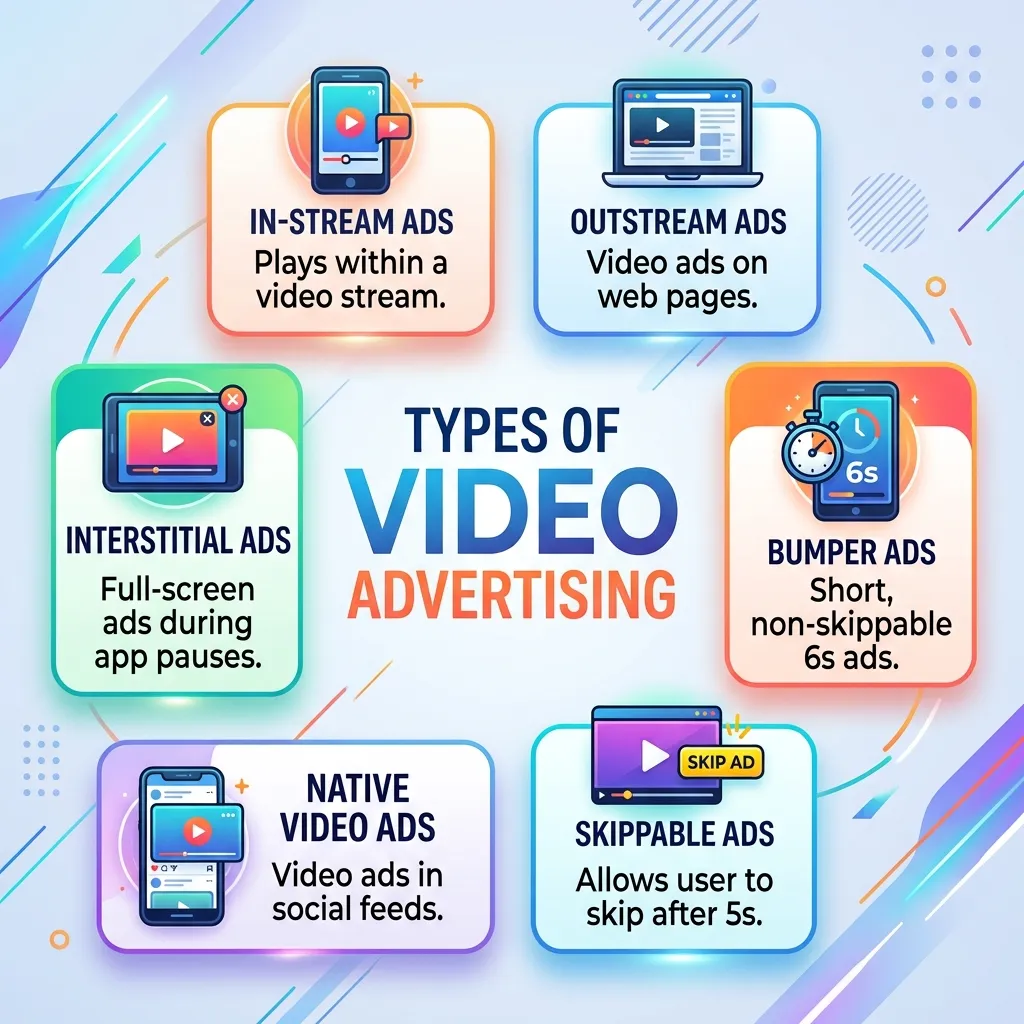
There are several types of video advertising, and the best choice depends on your campaign objective and audience.
In-Stream Video Ads
In-stream advertisements appear before, during, or after video content. These ads are commonly used to reach people while they are watching videos.
Out-Stream Video Ads
Out-stream advertisements appear outside traditional video players, often within articles or other publisher content.
They can help advertisers reach users who are browsing websites or mobile content.
In-Feed Video Ads
In-feed video ads appear within content feeds on social platforms or other digital environments.
Because these ads appear alongside organic content, the creative should feel natural to the platform.
Bumper Ads
Bumper ads are very short video advertisements designed to deliver a quick message.
They are useful for brand awareness and reinforcing simple messages.
Connected TV Advertising
Connected TV advertising allows brands to reach audiences through internet-connected televisions and streaming environments.
This format combines some characteristics of traditional television advertising with digital audience targeting and measurement.
Social Media Video Ads
Social media video ads can be used across platforms where users consume short-form and long-form content.
Brands can use them for awareness, engagement, traffic, lead generation, and sales.
Online Video Advertising
Online video advertising refers to video-based promotional campaigns distributed through internet-connected platforms.
Businesses can place video advertisements on:
- Video-sharing platforms
- Social media
- Websites
- Mobile applications
- Streaming services
- Publisher networks
- Connected TV environments
One of the biggest advantages of online advertising is the ability to target audiences based on various signals.
Advertisers can also monitor campaign performance and adjust budgets or creative based on actual results.
Video Advertising Examples
Different businesses can use video advertising in different ways depending on their industry and objectives.
Ecommerce Video Advertising
An ecommerce company can create product demonstration videos showing how a product works, highlighting key features, and ending with a direct shopping CTA.
SaaS Video Advertising
A SaaS company can use a product walkthrough to show how its software solves a particular customer problem.
Restaurant Video Advertising
Restaurants can showcase food, customer experiences, special offers, restaurant atmosphere, or behind-the-scenes content.
Real Estate Video Advertising
Real estate companies can use property tours, neighborhood videos, agent introductions, and client testimonials.
Education Video Advertising
Educational businesses can promote courses using instructor introductions, sample lessons, student testimonials, and educational tips.
These examples demonstrate that effective video advertising does not require every business to use the same creative style.
B2B Video Marketing
B2B video marketing helps businesses communicate with decision-makers, professionals, and organizations.
Common B2B video formats include:
- Product demonstrations
- Customer testimonials
- Case studies
- Webinars
- Expert interviews
- Explainer videos
- Thought-leadership content
- Product tutorials
B2B video should focus on business problems and outcomes rather than simply listing product features.
For example, instead of saying that software has a particular feature, the video can demonstrate how that feature helps a company reduce manual work or improve productivity.
Video Marketing for Ecommerce
Video marketing for ecommerce can help potential customers understand products before purchasing.
Useful formats include:
- Product demonstrations
- Unboxing videos
- Product tutorials
- Customer reviews
- User-generated content
- Product comparisons
- Lifestyle videos
- Before-and-after demonstrations
Video can reduce uncertainty by showing the product from different angles and demonstrating how it is used.
Video Marketing for SaaS
Video marketing for SaaS businesses is useful for explaining software products that may be difficult to understand through text alone.
SaaS companies can create videos explaining:
- Product features
- Software workflows
- Customer use cases
- Integrations
- Onboarding
- Product benefits
- Pricing options
- Common problems
A short and focused product demonstration can help prospects understand the value of a SaaS product before requesting a demo or starting a trial.
Video Marketing for Startups
Video marketing for startups can help new businesses introduce their products, explain their value proposition, and build trust.
Startups do not always need expensive production.
They can create:
- Founder videos
- Product demonstrations
- Educational videos
- Customer testimonials
- Short-form social content
- Behind-the-scenes videos
The priority should be clarity and relevance rather than unnecessary production complexity.
Video Marketing Campaign

A successful video marketing campaign usually follows a structured process.
Research
Research your target audience, competitors, customer problems, and market opportunities.
Strategy
Define the campaign objective, audience, message, platform, format, and budget.
Production
Create the script, record the video, edit the footage, add graphics, and prepare platform-specific versions.
Distribution
Publish or advertise the video through the selected channels.
Measurement
Monitor views, engagement, clicks, conversions, cost, and other relevant KPIs.
Optimization
Use performance data to improve targeting, creative, budget allocation, and future campaigns.
Video Advertising Platforms
Choosing the right video advertising platforms is essential for campaign performance.
Common platforms and environments include:
- YouTube
- Social media platforms
- Professional social networks
- Programmatic advertising networks
- Streaming platforms
- Publisher websites
- Mobile applications
- Connected TV
The best platform depends on where your target audience spends time.
For example, a B2B company may prioritize professional audiences, while a consumer brand may focus heavily on social video platforms.
Video Ad Formats
Different video ad formats can be used for different campaign objectives.
| Video Ad Format | Common Use |
|---|---|
| In-stream ads | Awareness and consideration |
| In-feed ads | Social discovery |
| Bumper ads | Short brand messages |
| Out-stream ads | Publisher and mobile environments |
| Vertical videos | Mobile and short-form content |
| Product videos | Ecommerce |
| Explainer videos | SaaS and complex products |
| Testimonial videos | Trust and consideration |
Creative should always be adapted to the platform and viewing environment.
Video Ad Targeting
Video ad targeting allows advertisers to reach audiences based on different characteristics and behaviors.
Depending on the platform, targeting may include:
- Demographic targeting
- Geographic targeting
- Interest targeting
- Behavioral targeting
- Contextual targeting
- Keyword targeting
- Remarketing
- Customer-list targeting
- Similar or lookalike audiences
The objective is to find the right balance between relevance and reach.
Extremely narrow targeting may reduce the number of potential customers, while overly broad targeting may waste advertising budget.
Video Marketing KPIs
Video marketing KPIs help marketers evaluate whether a campaign is achieving its objective.
Important KPIs include:
- Impressions
- Reach
- Video views
- View-through rate
- Average watch time
- Completion rate
- Engagement rate
- Click-through rate
- Conversion rate
- Cost per view
- Cost per acquisition
- Leads
- Revenue
- Return on ad spend
The correct KPI depends on the campaign goal.
For example, an awareness campaign may focus on reach and completed views, while an ecommerce campaign may prioritize purchases, CPA, and ROAS.
Video Marketing Analytics
Video marketing analytics provides insights into how people interact with video content.
Analytics can help identify:
- Which videos attract the most viewers
- Where audiences stop watching
- Which audiences engage most
- Which creative generates clicks
- Which placements produce conversions
- Which videos generate qualified leads
- How much revenue is associated with campaigns
Do not judge performance only by total views.
A video with fewer views may generate more sales or qualified leads than a video with a much larger audience.
Video SEO
Video SEO is the process of optimizing video content and supporting webpages to improve discoverability in search engines and video platforms.
Keyword Research
Identify the topics and search terms relevant to your target audience.
Use keywords naturally in video titles, descriptions, supporting content, and other relevant areas.
Video Titles
Create descriptive titles that clearly explain what the video is about.
A good title should serve both search intent and user expectations.
Video Descriptions
Write useful descriptions that provide context about the video.
Avoid filling descriptions with unnecessary keyword repetition.
Captions and Transcripts
Captions improve accessibility and allow users to understand video content even when audio is unavailable.
Transcripts can also provide additional textual context for search engines and users.
Video Thumbnails
A strong thumbnail can help attract attention and encourage users to watch the video.
The thumbnail should accurately represent the content rather than misleading viewers.
YouTube Video SEO
YouTube video SEO focuses on improving the discoverability and performance of videos on YouTube.
Important elements include:
- Relevant keywords
- Clear titles
- Useful descriptions
- Accurate thumbnails
- Captions
- Transcripts
- Audience retention
- Engagement
- Consistent content quality
YouTube optimization should prioritize user satisfaction. Keywords are useful, but the content itself must deliver what the viewer expects.
Video Schema Markup
Video schema markup is structured data that helps search engines understand information about video content.
A VideoObject implementation can communicate details such as:
- Video name
- Description
- Thumbnail URL
- Upload date
- Duration
- Content URL
- Embed URL
Proper structured data can make video information easier for search engines to interpret.
However, structured data should accurately represent the visible content and follow current search-engine guidelines.
Video Search Optimization
Video search optimization focuses on making video content easier to discover through search engines and video platforms.
A strong video search optimization process includes:
- Research search intent.
- Select relevant topics.
- Create useful video content.
- Optimize titles and descriptions.
- Add captions and transcripts.
- Create descriptive thumbnails.
- Improve the supporting webpage.
- Use appropriate structured data.
- Monitor search and engagement performance.
The goal should not simply be to rank a video. The goal is to create the most useful video for the user’s search intent.
Video Engagement Metrics
Video engagement metrics help marketers understand whether people are actually consuming and interacting with video content.
Important metrics include:
- Watch time
- Average percentage viewed
- Completion rate
- Audience retention
- Likes
- Comments
- Shares
- Saves
- Clicks
- Replays
These metrics can reveal whether the creative successfully captures and maintains attention.
However, engagement should always be connected to the campaign objective. High engagement without conversions may not necessarily indicate strong business performance.
Best Practices for Video Advertising
Businesses can improve video advertising performance by following several best practices.
Keep the Message Focused
One video should generally communicate one primary idea clearly.
Capture Attention Quickly
Use a strong opening that immediately communicates relevance or value.
Optimize for Mobile
Use appropriate framing, readable text, captions, and mobile-friendly creative.
Use Captions
Captions make video content more accessible and useful in sound-off environments.
Include a Strong CTA
Tell viewers exactly what action they should take next.
Create Multiple Versions
Develop variations of hooks, messages, CTAs, lengths, and visual approaches.
Match the Platform
A video designed for television may need significant changes before being used on a short-form social platform.
Measure Business Outcomes
Look beyond views and measure leads, sales, conversions, customer acquisition cost, and revenue where appropriate.
How to Build a Successful Video Advertising Campaign
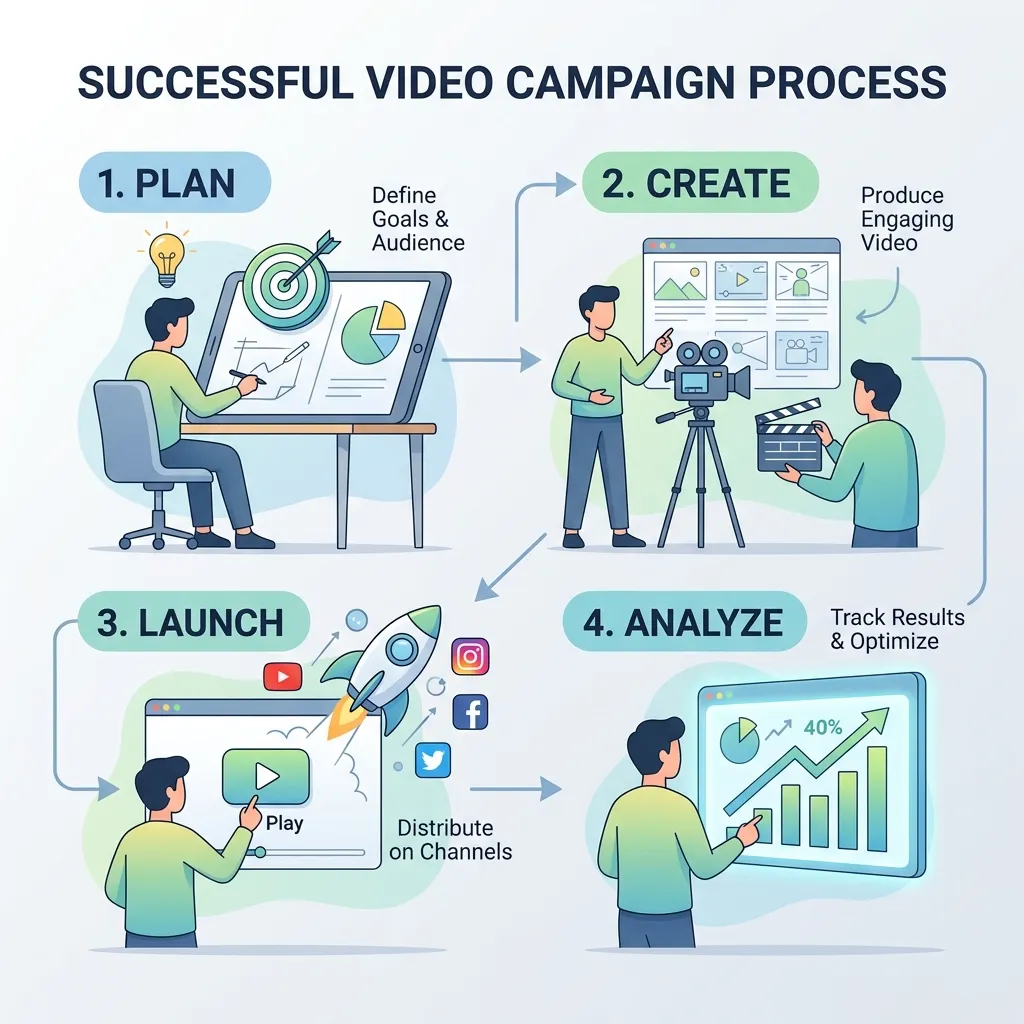
A practical video advertising workflow can be summarized as:
Goal → Audience → Message → Format → Platform → Creative → Targeting → Launch → Measurement → Optimization
Start by defining the business objective. Then research the audience and identify the problem your video should address.
Choose a platform and video format that match audience behavior.
Create a strong creative concept with a compelling opening, focused message, supporting visuals, and clear CTA.
After launching the campaign, monitor performance carefully.
Use video marketing analytics to identify strong and weak areas. Test new creative versions, adjust targeting, and allocate more budget toward strategies that generate meaningful results.
This continuous optimization process is what turns video advertising from a one-time campaign into a scalable marketing channel.
Conclusion
Video advertising gives businesses a powerful way to combine storytelling, visual communication, audience targeting, and measurable marketing performance.
From video advertising cost and video advertising strategy to video ad formats, targeting, platforms, analytics, and KPIs, every part of the campaign can influence its success.
Businesses can also strengthen their organic visibility through video SEO, YouTube video SEO, video schema markup, and video search optimization.
Whether you are working in B2B, ecommerce, SaaS, or a startup, the fundamental approach remains the same: understand your audience, define a clear objective, create useful and engaging video content, distribute it through the right platform, and continuously optimize based on data.
The most successful video advertising campaigns are not necessarily the campaigns with the biggest budgets. They are the campaigns that deliver the right message to the right audience through the right channel at the right time.
Frequently Asked Questions About Video Advertising
What is video advertising?
Video advertising is a marketing method that uses video content to promote a brand, product, service, or offer through digital platforms, websites, social media, streaming services, and other channels.
How much does video advertising cost?
Video advertising cost varies depending on production expenses, advertising platform, audience competition, campaign objective, targeting, geographic market, and bidding strategy.
What are the main types of video advertising?
Common types include in-stream ads, out-stream ads, in-feed ads, bumper ads, social media video ads, and connected TV advertising.
What is a video advertising strategy?
A video advertising strategy is a plan that defines the campaign objective, target audience, message, creative format, advertising platform, targeting, budget, and measurement process.
Which platform is best for video advertising?
There is no single best platform. The right choice depends on your target audience, campaign objective, industry, creative format, and budget.
What is video ad targeting?
Video ad targeting allows advertisers to reach specific audiences based on factors such as demographics, interests, location, behavior, context, and previous interactions.
What are important video marketing KPIs?
Important KPIs include impressions, reach, views, watch time, completion rate, engagement rate, CTR, conversions, CPA, leads, revenue, and ROAS.
What is video SEO?
Video SEO is the process of optimizing video content and supporting webpages to improve discoverability and visibility in search engines and video platforms.
Does YouTube video SEO improve visibility?
Effective YouTube SEO can improve video discoverability by optimizing relevant elements such as titles, descriptions, thumbnails, captions, and content quality.
What is video schema markup?
Video schema markup is structured data that helps search engines understand information about a video, including its name, description, thumbnail, duration, and upload date.
Is video advertising useful for small businesses?
Yes. Small businesses can use targeted video campaigns to reach specific audiences without requiring the large budgets traditionally associated with television advertising.
How can I measure whether video advertising is successful?
Measure performance according to the campaign objective. Awareness campaigns may focus on reach and video views, while conversion campaigns may focus on leads, sales, CPA, and ROAS.