Video has become one of the most effective tools an online store can use to turn browsers into buyers. Product demonstrations, unboxing content, customer testimonials, and live shopping streams all give shoppers something static photos and text descriptions can’t: a real sense of how a product looks, feels, and works before they commit to buying. This guide covers the core video marketing strategies built specifically for e-commerce, where to place video across the customer journey, how to measure its impact on sales, and the common mistakes that quietly limit results.
Online shoppers can’t pick up a product, try it on, or see it in motion the way they could in a physical store — video is the closest substitute available, and it consistently closes that gap better than any other content format. From a thirty-second product demo on a listing page to a full live shopping event, video marketing for e-commerce gives shoppers the confidence they need to click “buy” instead of leaving the page to compare options elsewhere.
This guide walks through the video formats that perform best for online stores, how to build them into every stage of the customer journey, and how to measure whether your video investment is actually paying off. If you’re building a broader content plan first, this complete guide to video marketing strategy is a useful foundation before applying these e-commerce-specific tactics.
Why Video Marketing Matters for E-commerce
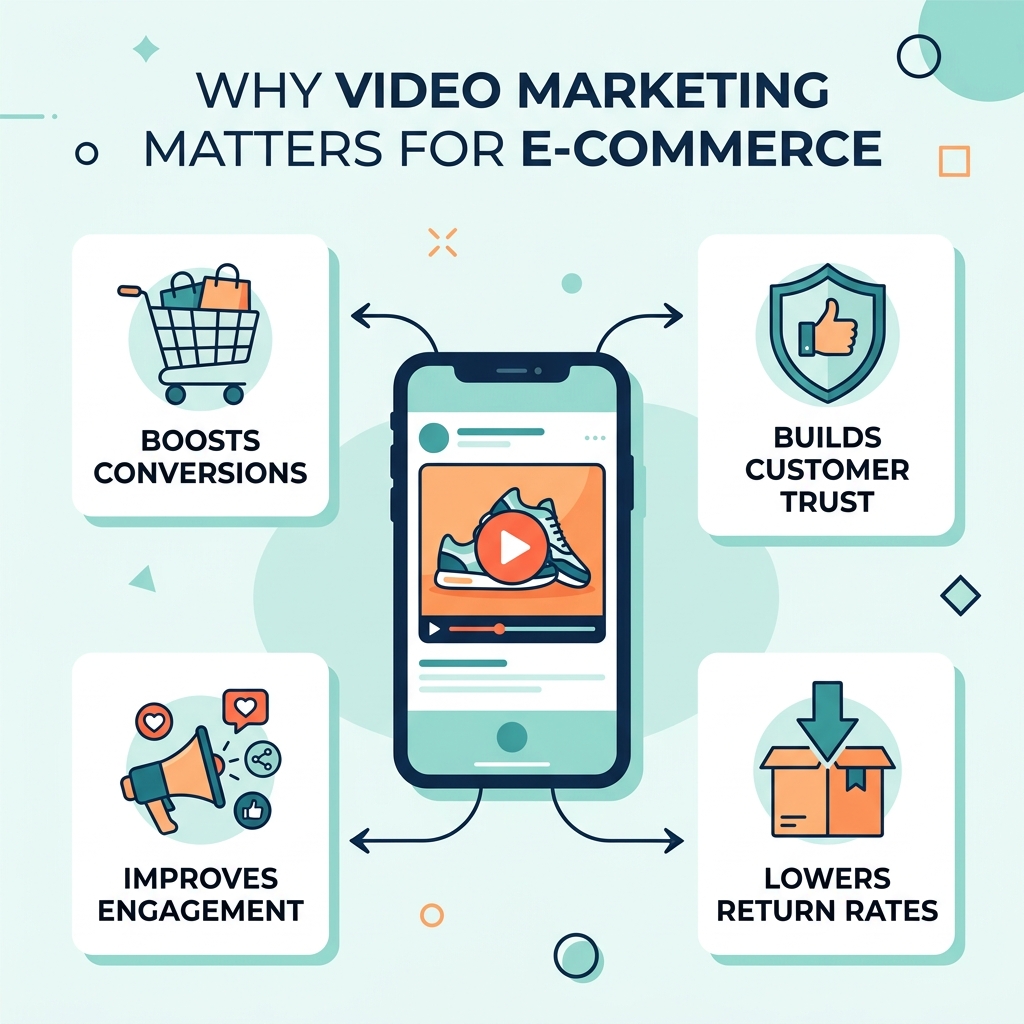
- Higher conversion rates. Product pages featuring video consistently see stronger add-to-cart and purchase rates than pages relying on images alone, since video reduces uncertainty about fit, size, and function.
- Lower return rates. When customers see exactly how a product works or looks in real use before buying, they’re less likely to be surprised — and disappointed — when it arrives.
- Stronger social proof. Customer testimonial and unboxing videos carry a level of authenticity that polished studio photography can’t replicate.
- Better SEO performance. Video content on product and category pages can improve time-on-page and reduce bounce rate, both of which support stronger organic rankings. This video SEO guide covers how to optimize video content specifically for search visibility.
- Multi-channel reusability. A single well-produced product video can be repurposed across the product page, email campaigns, paid ads, and social media, extending its value well beyond a single placement.
Core Video Formats for E-commerce
1. Product Demonstration Videos
Short videos showing a product in actual use — how it fits, functions, or solves a specific problem — remain the highest-impact format for product pages, directly addressing the hesitation that keeps shoppers from completing a purchase.
2. Unboxing and First-Impression Videos
Unboxing content taps into genuine curiosity and builds anticipation, while also showing real packaging and product condition, which helps set accurate expectations before purchase.
3. Customer Testimonial Videos
Real customers describing their experience with a product add a layer of trust that brand-produced content alone can’t achieve, and they work especially well on product pages and retargeting ads.
4. Live Shopping and Shoppable Video
Live shopping streams combine real-time demonstration with the ability to purchase directly within the video experience, creating urgency and interactivity that pre-recorded content can’t match. This guide to video shopping platforms breaks down how brands are integrating shoppable video directly into their storefronts.
5. Personalized Video Content
Dynamically generated videos tailored to a specific customer’s browsing or purchase history can significantly boost engagement compared to generic content. This approach to personalized video marketing for conversion shows how tailoring video content to individual shoppers improves both engagement and purchase intent.
6. Short-Form Social Video
Quick, attention-grabbing clips built for platforms like Instagram Reels and TikTok help e-commerce brands reach new audiences and drive traffic back to product pages. This guide to short-form video content covers how to create clips designed to perform well within those platforms’ algorithms.
7. Interactive and 360-Degree Product Video
Allowing shoppers to rotate a product view or interact directly with a video gives online buyers a closer approximation of an in-store experience. This overview of interactive video marketing explains how interactivity extends beyond passive viewing to actively support the buying decision.
Placing Video Across the E-commerce Customer Journey

Awareness Stage
Short-form social videos and paid video ads introduce new potential customers to a product, often before they’ve ever visited the website. This is where creativity and hook-driven content matter most, since the goal is capturing attention within the first few seconds.
Consideration Stage
Product demonstration videos, comparison content, and customer testimonials help shoppers evaluate whether a product fits their specific needs once they’ve landed on a product or category page.
Decision Stage
Retargeting ads featuring testimonial or unboxing content can push hesitant shoppers who abandoned a cart or left a product page back toward completing their purchase.
Post-Purchase Stage
Instructional or setup videos sent after purchase reduce support requests and improve customer satisfaction, while also creating an opportunity to introduce complementary products.
How to Build a Video Marketing Strategy for Your Store
Step 1: Identify Your Highest-Impact Products First
Rather than trying to produce video for an entire catalog at once, start with best-selling or high-return products, where video is most likely to move the conversion or return-rate needle quickly.
Step 2: Match Format to Funnel Stage
Use short, high-energy content for awareness, more detailed demonstration content for consideration, and authentic testimonial content for decision-stage retargeting, rather than using a single video type everywhere.
Step 3: Optimize for Mobile Viewing
The majority of e-commerce traffic happens on mobile devices, so videos should be filmed and edited with vertical or square formats in mind, with text and key visuals clearly legible on a small screen.
Step 4: Add Video to Key Product Pages First
Prioritize adding video to your highest-traffic and highest-value product pages before expanding across the full catalog, so you can measure impact on a manageable scale first.
Step 5: Repurpose Content Across Channels
A single product demo can be trimmed into a short social clip, embedded in an email campaign, and used as a retargeting ad, maximizing the return on the original production investment.
Step 6: Track Performance and Iterate
Monitor how video placement affects conversion rate, time on page, and return rate, and use those insights to guide which products or formats deserve further investment. Reviewing video marketing KPIs can help establish the right benchmarks before evaluating results.
Measuring Video Marketing ROI for E-commerce
Unlike broader brand awareness campaigns, e-commerce video marketing can often be tied directly to revenue. Key metrics worth tracking include:
- Conversion rate lift on product pages with video versus those without.
- Add-to-cart and checkout completion rates following video engagement.
- Return rate differences between products with and without demonstration videos.
- View-through and click-through rates for video ads driving traffic to the store.
- Average order value for customers who engaged with shoppable or personalized video content.
This guide to maximizing video marketing ROI covers additional methods for tying video performance directly back to revenue, which is especially important for justifying continued production investment to stakeholders.
AI and Video Marketing in E-commerce
AI tools are increasingly used to speed up video production, generate personalized variations at scale, and even auto-edit raw footage into multiple formats for different channels. This overview of AI video marketing tools shows how smaller e-commerce teams without dedicated video production resources can still produce a steady stream of content. On the personalization side, techniques used in AI personalization for e-commerce increasingly extend into video, allowing dynamically generated product recommendations to appear directly within personalized video content.
Video Marketing Examples Worth Studying
Looking at real examples can help clarify which formats fit your own catalog and audience. This roundup of e-commerce marketing examples that actually work includes several video-driven campaigns worth studying for inspiration, while this broader collection of video marketing examples that drive results offers additional formats and creative approaches across different industries.
Video Marketing Across Different E-commerce Categories
Not every product category benefits from video in the same way, and understanding these differences helps prioritize where to invest first. Fashion and apparel brands often see the strongest lift from fit and movement videos, since shoppers can’t try items on before buying and need to see how fabric drapes or moves on a real body. Beauty and cosmetics brands benefit heavily from application tutorials and before-and-after content, which directly addresses the uncertainty around shade matching or product texture.
Home goods and furniture retailers tend to perform best with room-context videos that show scale and styling in a realistic setting, since static product shots on a white background make it difficult for shoppers to judge how an item will actually look in their own space. Electronics and gadget sellers, meanwhile, often see the biggest impact from feature-demonstration videos that walk through specific functionality a written spec sheet can’t communicate as clearly.
Even within a single store, it’s worth tailoring the video approach category by category rather than applying one format uniformly across an entire catalog. A furniture brand’s best-performing video style will rarely be the same as a skincare brand’s, even if both are technically selling through the same e-commerce platform and marketing automation stack.
Common Mistakes in E-commerce Video Marketing
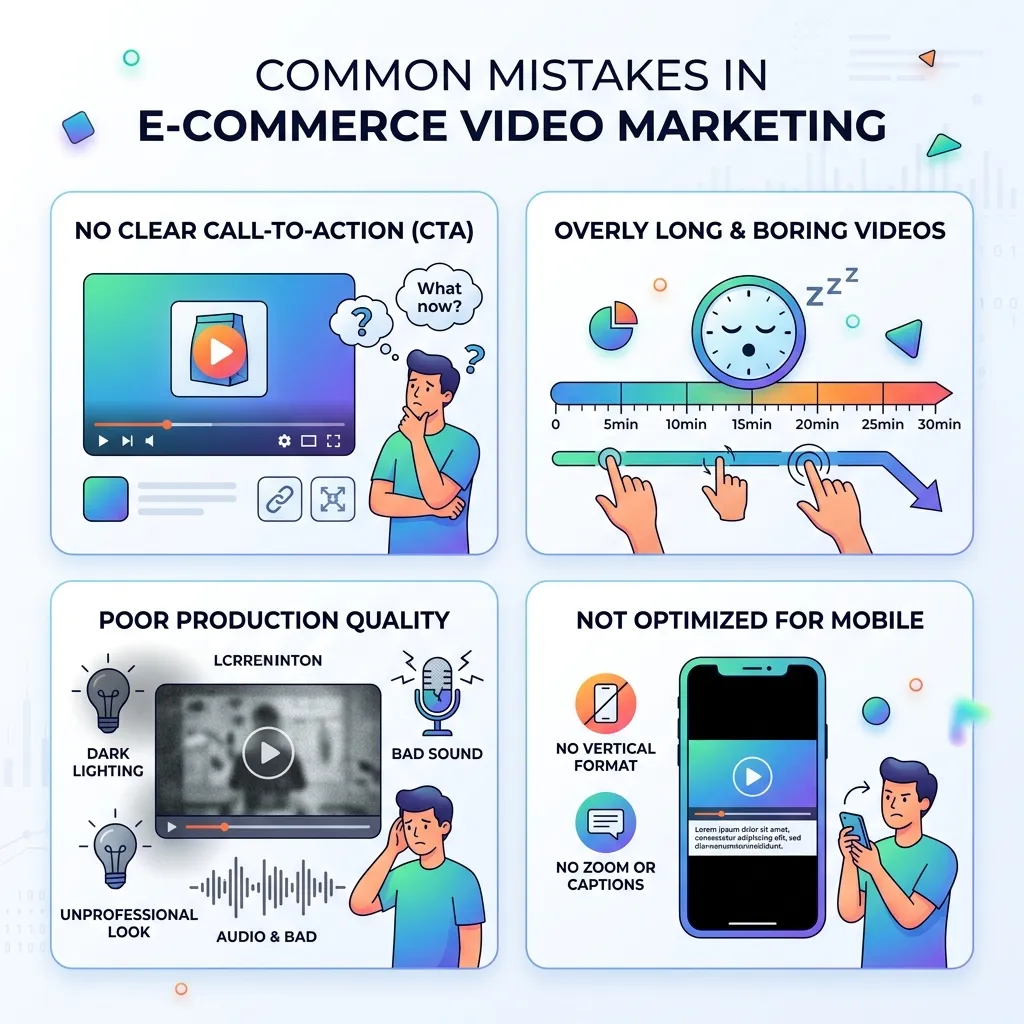
- Producing generic, overly polished content. Shoppers increasingly respond better to authentic, slightly raw content than to overly staged studio production.
- Ignoring mobile formatting. A video designed only for desktop viewing often loses impact or gets cropped awkwardly on the mobile devices most shoppers actually use.
- Skipping measurement. Without tracking conversion and return-rate impact, it’s difficult to justify further video investment or know which formats are actually working.
- Using the same video everywhere. A single format rarely serves every stage of the customer journey equally well.
- Neglecting video SEO. Failing to optimize titles, descriptions, and transcripts around video content leaves organic search value on the table.
- Overlooking personalization opportunities. Treating every visitor to the same generic video misses the stronger engagement personalized or dynamically tailored content can generate. Combining video with broader personalized video marketing principles can meaningfully improve engagement across a store’s highest-traffic pages.
Conclusion
Video marketing for e-commerce works because it closes the gap between a physical shopping experience and an online one, giving shoppers the confidence to buy without ever touching the product. The stores that see the strongest results treat video as a strategic tool tied to specific funnel stages and measurable outcomes, rather than a one-off production project. Start with your highest-impact products, match video format to where a shopper is in their journey, optimize for the mobile-first reality of e-commerce traffic, and track performance closely enough to know exactly which content is actually driving sales. Done consistently, video becomes one of the most reliable levers available for improving both conversion rates and long-term customer trust.
Frequently Asked Questions (FAQs)
1. Does video marketing actually increase e-commerce conversions?
Yes, product pages featuring video consistently show stronger add-to-cart and purchase rates compared to pages relying solely on static images.
2. What type of video should I start with for my online store?
Product demonstration videos are usually the best starting point, since they directly address the hesitation that prevents shoppers from completing a purchase.
3. Can video marketing reduce product returns?
Yes, showing accurate, real-use footage helps set correct expectations, which typically reduces returns caused by surprise or mismatched expectations.
4. Is live shopping worth investing in for a small e-commerce brand?
It can be, especially for brands with an engaged social following, since live shopping combines real-time demonstration with the ability to purchase instantly.
5. How long should e-commerce product videos be?
Most effective product videos run between 15 and 60 seconds, focusing on the key benefits and use cases rather than exhaustive detail.
6. Should video content be different for mobile versus desktop?
Yes, vertical or square formats with clearly legible text work better on mobile, where the majority of e-commerce traffic now occurs.
7. How do I measure the ROI of video marketing for my store?
Track conversion rate differences on pages with and without video, along with return rates, average order value, and click-through rates on video ads.
8. Can AI tools help small e-commerce teams produce video content?
Yes, AI-powered editing and generation tools can significantly reduce the time and cost required to produce a steady stream of product and marketing videos.
9. Where should video be placed in the customer journey?
Short-form and ad content works best for awareness, demonstration and testimonial videos for consideration, and retargeting video for hesitant shoppers at the decision stage.
10. Does video help with SEO for e-commerce sites?
Yes, video content can improve time-on-page and reduce bounce rate, both of which support stronger organic search performance when optimized correctly.
11. Is personalized video worth the extra production effort?
Often yes, since dynamically tailored content based on browsing or purchase history tends to drive stronger engagement than generic video shown to every visitor.
12. What’s the biggest mistake e-commerce brands make with video marketing?
Producing a single generic video and using it everywhere, rather than matching different video formats to different stages of the customer’s buying journey.
For a deeper foundation before planning your next production, see our complete video marketing strategy guide, or explore video marketing metrics for ROI to benchmark your existing content.