Choosing the right video marketing KPIs is the difference between a report that looks impressive and one that actually informs decisions. This guide breaks down which metrics matter at each funnel stage, how to separate signal from vanity numbers, and how to build a reporting structure that ties video performance to real business outcomes.
Video is one of the easiest marketing channels to generate impressive-looking numbers from and one of the hardest to measure honestly, which is exactly why choosing the right video marketing KPIs matters so much. A campaign can rack up hundreds of thousands of views while doing almost nothing for the business behind it, and a quieter campaign with far fewer views can quietly outperform it on revenue. The difference almost always comes down to which video marketing KPIs a team is actually tracking, and whether those numbers are tied to anything that matters.
This guide walks through the video marketing KPIs worth tracking at each stage of the funnel, explains why some commonly reported numbers deserve far less weight than they usually get, and lays out a practical framework for reporting video performance in a way that survives scrutiny from finance or leadership. Our complete guide to video marketing metrics covers the technical side of data collection in more depth, which is worth reading alongside this strategic breakdown.
Why Choosing the Right KPIs Matters More Than Collecting More Data
Most video platforms now surface dozens of potential video marketing KPIs — views, impressions, watch time, completion rate, click-through rate, engagement rate, and more. The temptation is to report all of them, which usually produces a dashboard nobody actually reads. The more useful approach is choosing a small set of video marketing KPIs that map directly to specific business questions, and treating everything else as supporting context rather than a headline number.
The right KPIs also change depending on what a video is meant to accomplish. A brand awareness video and a product demo video serve completely different purposes, and measuring both against the same metric — views, for instance — obscures whether either is actually working. Matching KPIs to campaign intent is the single biggest factor separating useful video reporting from noise.
Video Marketing KPIs by Funnel Stage
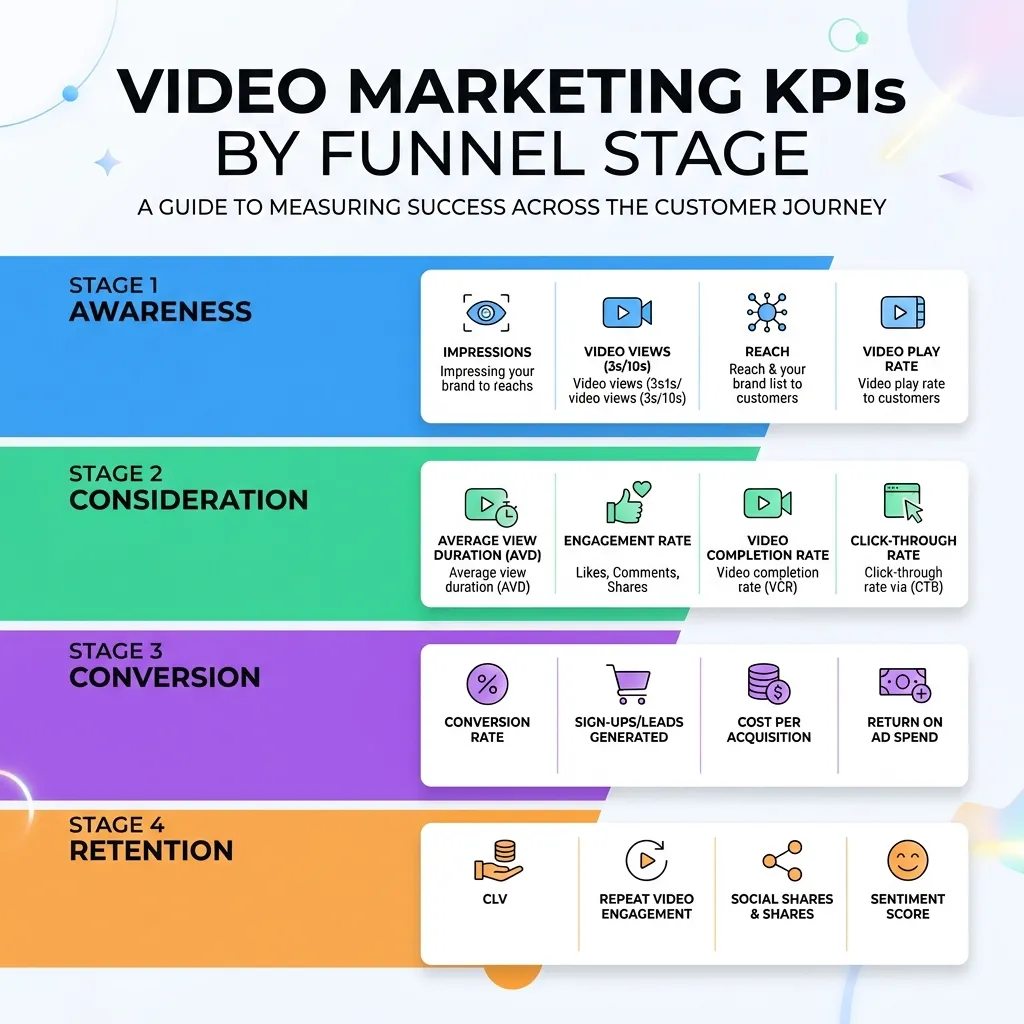
Awareness Stage KPIs
At the top of the funnel, the goal is reaching and registering with a new audience, so the relevant video marketing KPIs focus on exposure and initial attention rather than conversion.
- Impressions and reach — how many people were served the video, and how many unique viewers that represents
- View-through rate (VTR) — the percentage of people who started the video and watched a meaningful portion, distinguishing genuine attention from a scroll-past
- Average watch time and completion rate — how much of the video people actually watched, which signals whether the content itself is holding attention
- Brand lift — measured through surveys, this tracks whether exposure to the video measurably shifted brand awareness or favorability
Raw view counts alone are the weakest of these, since a view can register after just a few seconds on many platforms. Watch time and completion rate tell a far more honest story about whether the content is actually landing.
Consideration Stage KPIs
Once a viewer is aware of a brand, the next question is whether the video moves them toward evaluating a purchase.
- Click-through rate (CTR) — how many viewers took the next step, whether that’s visiting a website or a product page
- Engagement rate — likes, comments, shares, and saves relative to views, which signals whether content is resonating enough to prompt action
- Video completion by segment — comparing completion rates across audience segments can reveal which groups are actually interested versus which are being reached inefficiently
- Time spent on site after video view — a useful secondary signal for whether the video successfully primed a visitor for deeper engagement
Conversion Stage KPIs
This is where video marketing KPIs need to tie most directly to revenue, and where the reporting bar should be highest.
- Conversion rate — the percentage of video viewers who complete a desired action, such as a purchase, signup, or demo request
- Cost per acquisition (CPA) — the media and production cost divided by the number of conversions attributed to the video
- Return on ad spend (ROAS) — revenue generated relative to spend, particularly relevant for paid video campaigns
- Assisted conversions — conversions where video played a role in the path even if it wasn’t the final touchpoint, which matters because video frequently influences decisions earlier in a longer buying journey
Retention and Loyalty KPIs
Video also plays a role after the initial sale, particularly for SaaS and subscription businesses using onboarding or educational video content.
- Feature adoption rate following tutorial video views
- Support ticket reduction tied to explainer or how-to video content
- Repeat viewership of branded content among existing customers, which can signal ongoing engagement and reduced churn risk
Vanity Metrics Worth Deprioritizing
Not every number a platform surfaces deserves a place in a report. A few commonly cited metrics look impressive but rarely predict business outcomes on their own.
Raw view count is the most overused vanity metric in video marketing. A view can be counted after just a few seconds of autoplay, which means a high view count can coexist with almost no actual attention or interest. Pairing view count with completion rate and watch time gives a far more honest picture.
Follower or subscriber growth driven by a single viral video often doesn’t correlate with future engagement or purchase behavior, since much of that growth can come from viewers with no genuine interest in the brand. Tracking engagement rate among new followers over the following weeks is more informative than the raw growth number itself.
Total shares without context can mislead as well — a video shared widely for being funny or shocking, disconnected from the brand’s actual offering, contributes little to business goals even if the share count looks impressive in a report.
Building a Video Marketing KPI Reporting Framework
A useful video marketing KPI reporting structure starts by defining the specific goal of each video before it’s produced, since the goal determines which KPIs are relevant in the first place. A brand awareness video shouldn’t be judged primarily on conversion rate, and a bottom-funnel product demo shouldn’t be judged primarily on reach.
From there, reporting typically works best organized in three layers:
- Headline metric — the single KPI that answers whether the video achieved its primary goal
- Supporting metrics — two or three metrics that provide context for why the headline number looks the way it does
- Diagnostic metrics — granular data (drop-off points, device breakdown, audience segment performance) used to troubleshoot underperformance rather than reported to leadership by default
Our guide on how to report on video marketing results walks through this structure in more detail, including how to present findings to stakeholders who don’t need the full diagnostic layer.
Tools and Platforms for Tracking Video Marketing KPIs
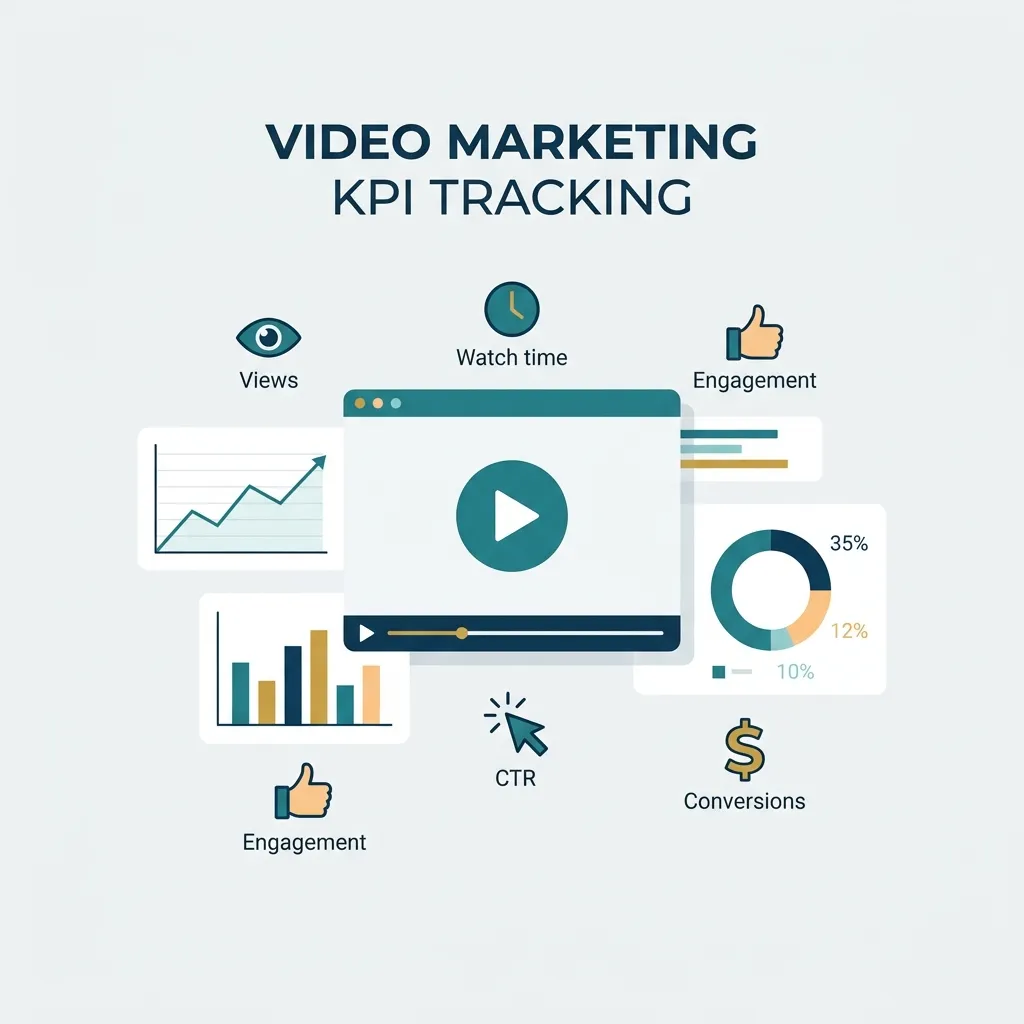
Native platform analytics — YouTube Studio, Meta’s video insights, TikTok analytics — provide solid baseline data for tracking core video marketing KPIs for platform-specific metrics like watch time, completion rate, and audience retention curves. These are usually sufficient for evaluating individual video performance on a single platform.
For cross-platform reporting and tying video performance to actual revenue, most teams need to layer in a web analytics platform and, where paid media is involved, conversion tracking through the ad platform itself. Our video analytics market overview covers how the broader measurement landscape has evolved, including the growing role of AI-assisted analysis for identifying which specific moments in a video drive drop-off or engagement spikes.
Attribution remains the hardest part of this picture. Video frequently influences a purchase decision without being the final click, which means conversion-focused metrics alone can understate video’s actual contribution. Multi-touch attribution models and incrementality testing — comparing outcomes for audiences exposed to video versus a holdout group — offer a more complete picture than last-click attribution alone, though both require more setup than most small teams initially have in place.
Common Mistakes When Tracking Video Marketing KPIs
Measuring everything against the same metric. Applying view count or CTR uniformly across awareness, consideration, and conversion content ignores that these stages have fundamentally different success criteria.
Reporting raw numbers without benchmarks. A completion rate or CTR is only meaningful in context — compared to past campaigns, industry benchmarks, or a controlled test — not as an isolated figure.
Ignoring negative signals. High drop-off at a specific timestamp, low completion on mobile relative to desktop, or declining engagement over a campaign’s run are all diagnostic signals that get missed when reporting focuses only on positive headline numbers.
Skipping incrementality. Without some form of holdout or comparison group, it’s difficult to know whether conversions attributed to video would have happened anyway through other channels.
Changing KPIs too frequently. Switching which metrics get reported from month to month makes it impossible to spot trends over time. Consistency in what gets measured matters almost as much as measuring the right things in the first place.
Aligning KPIs With Business Goals
The most reliable way to avoid vanity-metric reporting is starting from the business question a video campaign is meant to answer, then working backward to the KPI that answers it — rather than starting from whatever metrics a platform happens to surface prominently. A demo request goal points toward conversion rate and CPA; a brand awareness goal points toward reach, VTR, and brand lift; a customer education goal points toward feature adoption and support ticket reduction.
Our broader guide on maximizing video marketing ROI covers how to connect this KPI framework back to overall marketing budget decisions, including how to make the case for continued or increased video investment based on evidence rather than impressive-looking but ultimately disconnected numbers.
Where Emotional Response Fits Into Video Marketing KPIs

Standard video marketing KPIs capture behavior — who watched, who clicked, who converted — but they don’t directly capture why a video worked. Increasingly, teams are layering emotional response data alongside traditional metrics to understand what’s actually driving the numbers, not just what the numbers are.
This growing field of emotion-focused measurement gives useful context for interpreting KPI patterns that otherwise look confusing. A video with strong completion rate but weak conversion, for instance, might be generating interest without building enough trust or urgency to prompt action — a gap that behavioral metrics alone can’t fully explain. An outside resource on emotion analytics covers how this kind of measurement is being applied across marketing more broadly, and a related piece on using predictive analytics to boost ROI explains how emotional and behavioral signals are increasingly combined to forecast which content is likely to convert before a full campaign has run its course.
For most teams, this doesn’t mean adopting dedicated emotion-tracking software immediately — it means treating qualitative signals like comment sentiment and drop-off timing alongside the quantitative KPIs already being tracked, rather than as an afterthought.
Conclusion
Video marketing KPIs only matter to the extent they answer a real question about whether a campaign is working. Raw view counts and follower growth make for easy headlines, but they rarely predict whether a video actually moved the business forward. The more reliable approach organizes metrics by funnel stage, treats vanity numbers as context rather than headlines, and consistently ties reporting back to the specific goal each piece of video content was created to achieve. Teams that build this discipline into their reporting tend to make better decisions about where to keep investing in video and where to cut — decisions that view counts alone simply can’t support.
Frequently Asked Questions About Video Marketing KPIs
1. What Are the Most Important Video Marketing KPIs to Track?
It depends on the funnel stage. View-through rate and completion rate are important for awareness content, engagement rate and CTR for consideration content, and conversion rate and CPA for bottom-funnel campaigns.
2. Is View Count a Reliable Video Marketing KPI?
On its own, no. Views can be counted after only a few seconds of playback, making them a limited indicator of genuine interest. Pairing view count with completion rate provides a more useful performance picture.
3. How Do You Measure ROI From Video Marketing?
Video marketing ROI is typically measured by comparing revenue or conversions attributed to video with total production and media costs. Incrementality testing can provide additional insight beyond last-click attribution.
4. What’s the Difference Between Engagement Rate and View-Through Rate?
Engagement rate measures actions such as likes, comments, and shares relative to views, while view-through rate measures the percentage of viewers who watched a meaningful portion of the video.
5. Should Every Video Be Measured Against the Same KPIs?
No. A video’s objective should determine which KPIs matter most. Awareness, consideration, and conversion videos require different performance measures.
6. What Tools Are Commonly Used to Track Video Marketing KPIs?
Native platform analytics such as YouTube Studio, Meta Insights, and TikTok Analytics provide platform-specific metrics. Web analytics and conversion tracking tools can then help connect video performance with website actions and revenue.
7. Why Is Attribution Difficult for Video Marketing?
Video often influences a purchase decision without being the final interaction before conversion. As a result, last-click attribution can underestimate video’s contribution to the customer journey.
8. What Is Incrementality Testing in Video Marketing?
Incrementality testing compares outcomes between an audience exposed to a video campaign and a similar holdout audience that was not exposed. This helps estimate the campaign’s additional impact beyond what would have happened naturally.
9. How Often Should Video Marketing KPIs Be Reviewed?
Many teams review core KPIs monthly, with more frequent monitoring during active campaigns. Regular checks can help identify underperformance early enough to adjust targeting, messaging, or creative.
10. What’s a Vanity Metric in Video Marketing?
A vanity metric is a number that may look impressive but does not reliably indicate meaningful business results. Examples include raw view counts or follower growth from a viral post that does not generate sustained engagement or conversions.
11. Can Video Marketing KPIs Help With Content Strategy, Not Just Ad Performance?
Yes. Metrics such as audience drop-off points and completion rates by segment can show which topics, formats, and content structures hold attention, helping teams improve future video production.
12. What’s the Biggest Mistake Teams Make When Reporting Video Marketing KPIs?
A common mistake is reporting every available metric without prioritizing the KPIs that directly answer whether the campaign achieved its objective. This can create complicated dashboards that provide data without supporting clear decisions.